
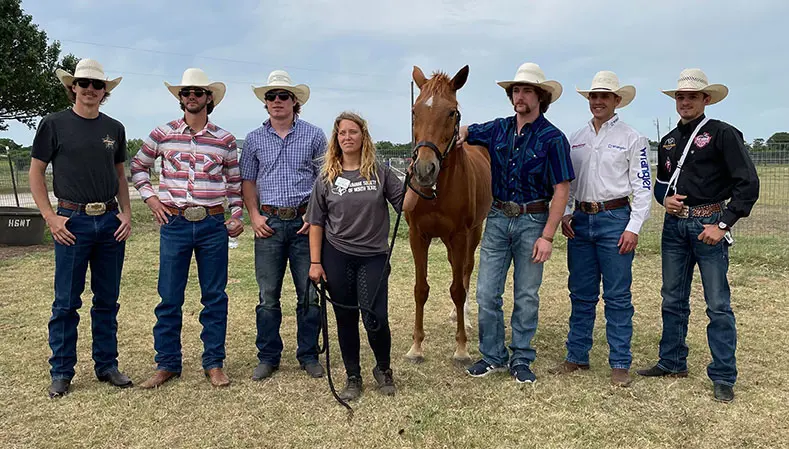
FORT WORTH, Texas – On the last off day before the 2022 PBR World Finals resumes in Fort Worth, Texas, a group of the PBR’s finest found themselves face-to-face with an animal even more daunting than a 1,500-pound bucking bull.
He was a mammoth donkey named Zeb.
He might not’ve been trying to buck anyone off, but mammoth donkeys stand at least 14 hands high. Ezekiel Mitchell stood next to Zeb’s head and commented that it was half as long as his body.
“This is the world’s largest donkey,” Clayton Sellars deadpanned.
Zeb is one of the ambassador animals for the Humane Society of North Texas (HSNT), so he relished the attention – and the scratches – that he got from the group that included Mitchell, Sellars, Brady Oleson, Marcelo Procopio Pereira, Brandon Davis, Josh Frost and Conner Halverson, bullfighter Lucas Teodoro and stock contractor Chad Berger.
They were at the Humane Society to volunteer as part of the Rider Day of Service dedicated to giving back to the Fort Worth community. On Tuesday, another group of riders visited Cook Children’s Medical Center.
The group was at the 30-acre ranch in Joshua, Texas, for several hours Wednesday morning, mending fences and giving horses baths.
View this post on Instagram
“It’s pretty cool being here, just because I used to watch the humane shows on Animal Planet all the time when I was a kid,” Mitchell said. “So being here is pretty cool.”
While the Humane Society is most typically known for its work in taking care of more traditional household pets like dogs and cats, the ranch is home to livestock. It can house anywhere from 10 to 50 animals and currently hosts 26.
“We’ve had goats here, pigs here, a llama,” said Ellen Rawlins, Vice President of Operations. “And on our main campus, there are dogs and cats and rabbits and guinea pigs. We have four satellite locations, a main campus for intake, and our 30-acre ranch. So there’s a lot of movement. At any time, we could have about a thousand animals in our care.”
The HSNT receives its animals in a variety of ways. In some cases, they take in horses whose families surrender them because they cannot properly care for them anymore. Sometimes, however, there are cruelty cases, where the HSNT rescues horses from neglectful environments. A week or two ago, they took in 12 such horses from one property.
“We have somebody who tries to work with the families, and if that doesn’t happen, we pursue through the courts, following the law,” Rawlins said. “And once the animals are in our care, we take over with our veterinarians and trainers to bring the horse up to where it needs to be just to be a horse, weight-wise, health-wise. And then we work on, who is this horse? Is he a trail horse? A companion horse? And then we have trainers that work with our staff that allow them to see through training how the horse and the human reconnect.”
The HSNT is not a sanctuary, so for every horse that gets taken in, the goal is for it to be adopted out. While adopting cats and dogs has grown in popularity over the last few decades, Rawlins says people are just starting to understand the value of adopting horses.
“We know a lot about our horses,” Rawlins said. “They might be with us 30, 60, 90 days, six months, nine months, depending on what process they’re going through to become adoptable, or if they are already. We just plug in on our website with a bio and all their medical records for when people go to adopt.
The HSNT staff worked throughout the COVID-19 pandemic as essential workers. While they expected to be slammed, adoptions actually dropped off because more people were spending time at home with their animals. They typically average 700 adoptions per month, from birds to horses, and also transport, foster and rescue animals.
The ranch once had 300 head of cattle from a cruelty case.
“You never know what’s around the block,” Rawlins said. “I mean, seriously.”
The HSNT relies on its volunteer program to get work done more efficiently. While groups like the PBR will often come through, individuals can sign up to volunteer online.
“We bring new people in who’ve never been around horses and want to experience what it’s like, to people downtown who like to walk dogs or wash dishes,” Rawlins said. “Our volunteer program has really allowed us to do so much more with the animals, because there’s trench work. You’ve got to wash dishes, change litterboxes, do laundry, so we’re fortunate as a health organization that it’s a business model. So people know that we’re on teams, and all these teams talk to each other, and these volunteers are really enveloped into our organization.”
Every bull rider at the ranch on Wednesday has horses of his own, so all knew what they were in for and were comfortable handling the animals. Even Zeb, whose braying can be heard anywhere on the property when he really gets going.
All the adoption-ready horses are listed on the HSNT’s website, and Rawlins encourages anyone looking for a horse to consider adoption.
“There’s no barriers with horses that need another part of their journey. And there’s data out there that confirms horses may have up to seven owners on their journey. So they’re pit-stopping here, is what we call it,” she said with a laugh. “They’re in our care on their journey.”