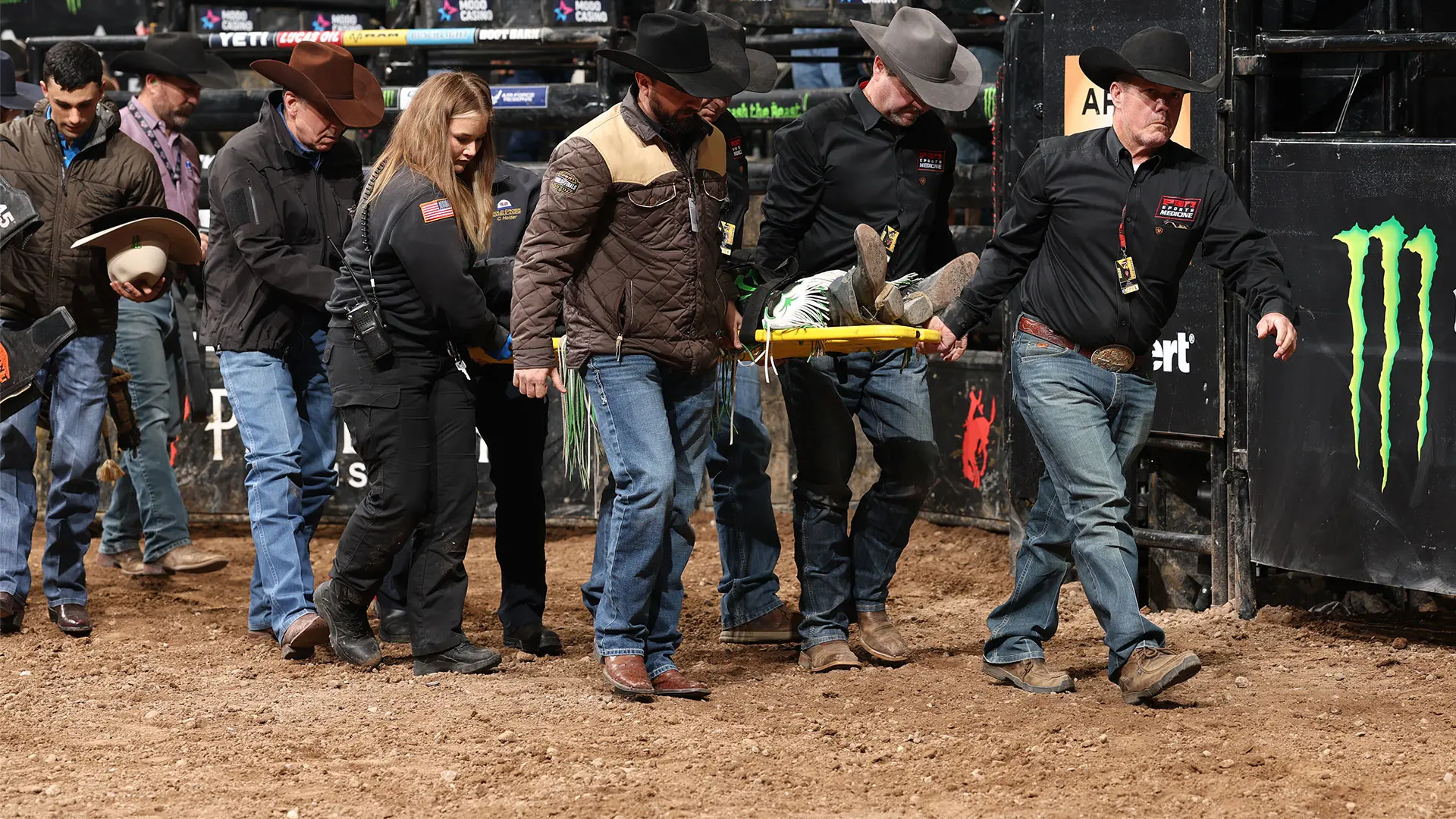
In a game of seconds and inches, bull riding can flip in the blink of an eye. One minute, a 20-year-old kid with fiery flowing locks is headed back to his hotel room with Cold Stone ice cream in hand, enjoying life, joking with his buddies, living out the dream. The next minute, nothing but silence and dark.
Saturday night inside Delta Center was loud in the way PBR crowds always are, right up until they weren’t.
World No. 2 Clay Guiton nodded for his Round 2 out aboard Lieutenant Dan near the end of the long round, with his best friends John Crimber and Kaiden Loud still left to ride and the energy in the building climbing toward the championship round.
Then, in a split second, the noise turned into screams.

Guiton was unseated in a violent change of direction near the chutes, his head snapping to the ground with a force that looked like it shut the lights off instantly. The g-force knocked him unconscious, and the wreck kept getting worse. As he hit, he was repeatedly stepped on — shoulder, stomach and what looked like his chest — while Lieutenant Dan stormed around the fallen rider.
With each hoof strike, the arena gasped. Then people saw it: Guiton’s body convulsing on the dirt.
A grand mal seizure.
Children began to cry. Fans screamed. And in the chaos, the bullfighters went to work.
Austin Ashley, Lucas Teodoro and Cody Webster fought to pull the bull off the downed rider and clear the arena floor. Before the bull was even fully out, John came flying over the chutes landing hard on his "tender leg" and leaning in, eyes locked on the scene. Webster began urgently waving for the EMTs and sports medicine.
Then something eerie happened.
Everything went quiet.
The announcers asked the crowd to remain silent so medical staff could communicate clearly. Cowboy hats came off almost in unison, a prayer rising from every corner of the arena. Teammates and competitors stood frozen, staring at the worst-case outcomes nobody wanted to say out loud: broken ribs, punctured lungs, brain bleed, internal damage. Bull riding has seen lesser wrecks end with those results.
Near Guiton’s feet, Marco Rizzo and Ezekiel Mitchell stood watching sports medicine take control, praying while the young rider lay convulsing on the dirt.
“We all pray for protection,” Rizzo said later. “In that moment, Zeke kept telling me, ‘Just have unwavering faith.’”
As Dr. Tandy Freeman reached the rider, another danger revealed itself. During the seizure, Guiton was choking on his mouth guard — it was slipping down his throat. Freeman removed it while medical staff rushed out the backboard, even as Guiton continued seizing. The building stayed silent, the kind of silence that feels heavier than noise.
“I’ve seen some pretty bad wrecks,” Rizzo said. “But that was just the whole seizure thing. It freaked me out.”
When the backboard finally moved, Rizzo walked out of the arena beside it, holding Guiton’s vest and carrying both his own hat and Guiton’s, still praying.
He never left his side again, more loyal than a hunting lab on a duck hunt, Marco Rizzo stayed by his buddy’s side.
In the moments that followed, Guiton regained consciousness in flashes — on the backboard, then in sports medicine, then in the ambulance on the way to the emergency room. He doesn’t remember the ambulance ride at all.
Rizzo does.
In the ambulance, EMTs reached for trauma shears to cut off Guiton’s glove. Rizzo stepped in.
“They were trying to cut his glove off,” he said. “I told them, this gear is expensive. If you need me to take anything else off, just call me.”
At the hospital, the cutting continued. When Guiton woke up later, the first thing he could focus on was not a scan result or a doctor’s voice.
“I remember John came up to me and showed me my chaps had been cut off of me,” Guiton said. “I was not very happy about that.”
Bull riders might ride 1,800 pounds of twisting horsepower without flinching, but cut their gear and you have committed a personal offense. The problem? Trauma rule No. 1 is simple: full exposure of the patient. When seconds matter, shears beat snaps. Doctors are not worried about leather. They are worried about lungs. Still, that did not make it easier when Guiton woke up to find his nearly new Monster Energy chaps, earned just months earlier, sliced apart in the name of saving his life.
If the torn leather felt personal, the next 20 hours were bigger than any strap or buckle.
A grand mal (generalized tonic-clonic) seizure can happen after a hard head injury. In simple terms, when someone gets knocked out, the brain can try to “jump-start the engine” — sending a surge of electrical activity through both sides of the brain as it attempts to reconnect. That sudden electrical storm causes violent convulsions. It’s a medical emergency. In cases like Guiton’s, doctors administer sedatives to stop the seizure, protect the airway and stabilize the patient while they evaluate for internal injuries and brain trauma.
Guiton slept for nearly 18 of the 20 hours he was there, drifting in and out under the weight of a concussion and medication.
While he rested, Rizzo handled conversations with doctors and nurses. Every time Guiton cracked his eyes open, no matter how foggy he was, Rizzo leaned in with the same three steady words: “You good, bubba?”
He also called Guiton’s mom, Brandy, because he knew what a mother’s fear sounds like, especially from hundreds of miles away. Both he and Guiton have moms on the East Coast, and Rizzo said he could only imagine how his own mother would have felt if it were him in that bed. So he stayed on the phone with Brandy, giving her steady updates instead of silence.
And before the night was even over, Carolina family had already mobilized. Tiffany Davis, alongside her husband, Carolina Cowboys head coach Jerome Davis, had already prepared a flight to get Brandy to Utah if needed. Carolina is not just a team. It is a family.
The first conversation between mother and son was simple. Guiton, still groggy, answered softly, “Hey mama.” Brandy replied, “Hey buddy,” and Guiton followed with the words she needed most: “I’m all right.” Rizzo said it sounded like the weight of the world lifted off of her shoulders.
Then enter the cowboy family, through glass emergency room doors.
Guiton’s room filled with friends — Cooper Davis, Jess Lockwood, Hudson Bolton, John Crimber, Kaiden Loud, Kase Hitt and others making their grand entrance in hats and boots, checking on the kid who had just turned an arena full of fans into a prayer circle.
“It goes to show how good a person Clay is,” Rizzo emphasized.
Not everybody has an entire entourage of cowboys walking into the ER for them.
Doctors performed CT imaging from Guiton’s brain down through his pelvis. There was concern he’d broken his jaw. There was concern about his chest. There was concern about everything you worry about after you watch a rider get stepped on while unconscious.
And then the results came back.
Clear.
“I didn’t break not one bone,” Guiton said. “To have a wreck look like that… it’s pretty crazy.”
There was a spot on his chest that briefly raised questions, but it turned out to be an old mark. Everything else came back good. No catastrophic internal injuries. No fractures.
“It was scary till I got to the hospital and then they told me he was gonna be all right,” Rizzo said. “At the moment, I didn’t think Clay was going to make it out with just a bump and bruise… but the good Lord had different plans.”
Two days later, after finally seeing the video himself, Guiton said what a lot of people in that building were already thinking.
“Nothing short of a miracle from God.”
He was discharged Sunday afternoon from the hospital. Before the wreck, he had been scheduled to attend the Monster Energy retreat in Park City, Utah — a few days of snow-filled activities and time with fellow riders. Marco, on the other hand, had planned to fly home Sunday morning. Instead, he stayed at Clay’s side yet again.
Sunday night, the two of them made their way to Park City together.
While the rest of the Monster crew took part in snowboarding, sledding and mountain shenanigans, Clay rested. He slept most of Sunday and Monday, recovering from the concussion and the heavy sedatives of the weekend. But in true competitor fashion, he did become vertical long enough to play a game of pool and spend time with the guys.
By Tuesday, he was ready to leave Utah alongside his fellow Monster riders — bruised, sore and still under concussion protocol — but walking out on his own two feet.
He’s not rushing it, though.
“Yeah, it’s going to be tough, especially with as tight as things are right now at the top,” Guiton said. “But I’m not gonna rush it. I’m just gonna take this time and be ready for when I come back.”
There’s proof — and solace — in that mindset. Just last season, José Vitor Leme reminded the entire locker room that a gold buckle isn’t won in February. His World Finals run showed that even if you miss an event or two, you can still be in the dogfight when it matters most in Fort Worth. For Guiton, he’s taking that example. The goal isn’t to be first in the winter — it’s to be first in May.
He’ll follow up with a neurologist next week and complete full concussion protocol testing before he’s cleared to ride again. There’s no rushing that process. And if you had to wager, a brand-new pair of chaps is probably already in the mail.
Rizzo, still turning the night over in his mind, said it the way only a bull rider can.
“We pray for nothing more than a couple bumps and bruises,” he said. “And that’s exactly what Clay got.”
If you want to understand how heavy that sentence is, go back to the silence.
Go back to the moment when a sold-out stadium of people stopped breathing. When children were crying. When a 20-year-old with a gold buckle dream lay motionless under arena lights. When worst-case scenarios felt closer than hope.
Then remember what happened next.
The screaming faded. The hats came off. The prayers went up.
And everybody, for a long few minutes, begged the same thing from the same place.
Let the kid get up. Let him go home. Let this end differently.
And it did.
Photo courtesy of Bull Stock Media