02.05.26 - News
The Lockwood monster is back
After years of pain, addiction, and doubt, Jess Lockwood has fought his way back to the top—smiling through the scars and chasing a third gold buckle.
By Harper Lawson
After years of pain, addiction and doubt, Jess Lockwood has fought his way back to the top, smiling through the scars and chasing a third gold buckle.
The first time the world saw Lockwood lift a gold buckle, he was barely old enough to legally order a drink. At 20 years old, the quiet kid from Volborg, Montana, stood at the top of professional bull riding, fearless and seemingly untouchable. Two seasons later, he did it again, becoming the youngest two-time world champion in the sport’s history.

Back then, Lockwood rode with the calm confidence of someone who had never known defeat. He was the sport’s future, the next face of bull riding, the kind of athlete who made eight seconds look effortless. The wins came quickly. The expectations came faster. And while Lockwood handled success with maturity beyond his years, bull riding has always demanded a price.
That price came in pain.
During his championship runs and the years that followed, Lockwood’s body endured the kind of punishment that ends careers. Early in his first title season, he tore a groin muscle completely off the bone. Later, a bull came down on his torso with a force comparable to being thrown from a third-story window, breaking ribs, puncturing his lung and lacerating his kidney. He broke his collarbone. He tore his hamstring off his pelvis. A kick to the back of the head split his neck open. Doctors stitched him back together again and again, stapling his scalp, reattaching the tip of his tongue and part of his ear. And every time, Lockwood returned to the arena with the same determination.
But physical injuries often leave invisible ones behind.
After his second pelvic surgery and a failed marriage, Lockwood found himself facing a battle no amount of grit could muscle through.
“I had feelings and thoughts in my head that were just eating at me,” he said.
He began using Adderall, not for performance, but to escape.
“It was something that I used continuously because I was afraid of the feeling of falling into withdrawal. I really didn’t care about anything, friends, family. It was a very selfish part of my life.”
As the addiction deepened, bull riding drifted further from view.
“I don’t really need bull riding,” he remembered thinking. “I’m kind of doing my own thing right now with all this.”
The young star had strayed so far from reality that the sport that once gave him purpose no longer seemed necessary.
The turning point came not in an arena, but on the road. After his relationship ended, Lockwood snapped back into reality. His family stepped in. His aunt, decorated barrel racing champion Lisa Lockhart, offered him a way out. He joined her on the rodeo trail, away from home, away from hiding.
“There wasn’t any sneaking stuff around,” he said. “And I made the decision to quit cold turkey.”
Withdrawal was painful. Not just physically, but emotionally, because sobriety forced Lockwood to confront everything he had been running from. The physical symptoms were there, but so was the psychological guilt. The kind of guilt that settles in when an addict finally wakes up and realizes how much they’ve changed over the years, how they’ve drifted into someone they barely recognize, someone they never wanted to become. There is guilt for the selfishness that addiction demands. Guilt for the relationships strained. Guilt for not quitting sooner.
But the long drives, the conversations, the miles between towns slowly began to quiet that noise.
“Being out there with her made it feel like the good old days,” he said.
When the fog finally lifted, the fire was still there. He hit the gym. He returned to the practice pen.
“As soon as I had a clear conscience, I hopped into the pen and I was hungry again.”
In 2025, Lockwood was signed as a free agent by the Carolina Cowboys.
“No one else really believed in me at that point,” he said. “I was kind of like the flu for all the other teams. The big question was: Is Jess going to be his normal self when he comes back riding?”
Carolina didn’t just give Lockwood a roster spot. They gave him something to believe in again. They gave him another family.
With teammates like Cooper Davis and Derek Kolbaba, and under the guidance of coach Jerome Davis and general manager Austin Dillon, Lockwood found what he didn’t know he was missing, people who believed in him even when he didn’t. People who pushed him. Who reminded him who he was and who he could still be. They gave him purpose, community and accountability. They gave him back his faith, not just in the Lord, but in himself.
He stumbled early, but Carolina never wavered. They went all in on Jess Lockwood, and in Las Vegas, the gamble paid off.
At the 2025 PBR Teams Championship, Lockwood delivered a 90.25-point dagger on Oyster Creek Brawler, sealing a key matchup win over the Nashville Stampede. It was the kind of moment that defined Carolina’s march to the title and redefined Lockwood’s return.
He broke his collarbone on championship Sunday, but later said, “I’d give up one of my regular season titles for that Teams championship. That one was for my family, my team and everyone who helped me beat addiction.”
At the 2025 PBR Teams Championship, Lockwood delivered a 90.25-point dagger on Oyster Creek Brawler, sealing a key matchup win over the Nashville Stampede. It was the kind of moment that defined Carolina’s march to the title and redefined Lockwood’s return.
He broke his collarbone on championship Sunday, but later said, “I’d give up one of my regular season titles for that Teams championship. That one was for my family, my team and everyone who helped me beat addiction.”
Back in Montana, he had doubled down on recovery over the years. He built a high-performance rehab hub in his home, complete with a Game Ready ice machine with knee attachments, red light therapy, compression systems and a sauna. Everything was deliberate. It is this unwavering commitment to recovery that has allowed him to keep coming back, stay healthy and extend his longevity in one of the most unforgiving sports on earth.
Before the Teams Championship in Las Vegas, coach Davis saw it coming.
“This is the freshest Jess has been all year,” Davis said at the time. “A fresh Jess Lockwood is dangerous, and I’m glad he’s on our team and not somebody else’s.”
Lockwood entered the 2026 Unleash The Beast season physically rebuilt and mentally reborn. He notched round wins in New York and Milwaukee, but everything came together in Tampa.
He opened the weekend with a slick 89.5-point ride on Raider, a bull that spun away from his hand. He found a way to adjust and triumph, just like he has in life.
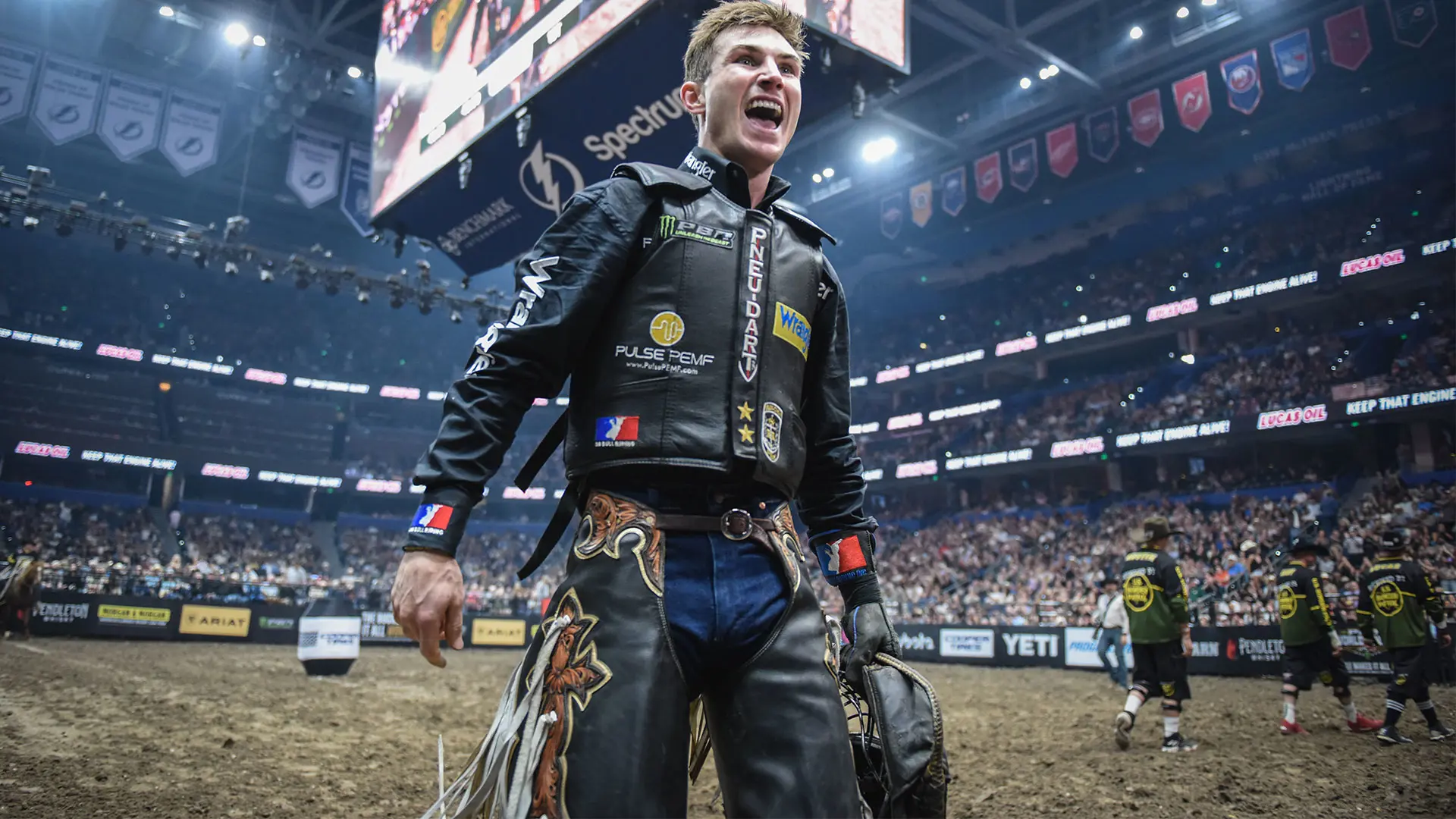
By Championship Saturday, Lockwood was in position. After Clay Guiton fired a 90.9-point ride on Sober Child, Lockwood needed a big one on Lights Out to take the buckle. He nodded. He rode. He won. 90.35 points. His first elite tour victory since 2020. A walk-off ride in every sense.
But the celebration was short.
Lockwood sprinted to the locker room, feeling tingling in his arms. The dismount had scared him. It felt like something was wrong with his neck. He skipped the arena interview and went straight for help. Later that night, he walked back into the hotel in a precautionary neck brace, still smiling.
Dr. Tandy Freeman confirmed the diagnosis: slight bulging discs and a re-aggravated wrist fracture from a past injury. Not season-ending. Just a bump in the road.
“Ice and tape and we’ll be good to go,” Lockwood said.
He missed Sacramento, but the comeback is far from over. Lockwood is slated to return to action in Salt Lake City, where he will face Saigon on the dirt Feb. 6–7 for PBR Salt Lake City presented by Busch Light.
“I’m as mentally ready and mature right now as I’ve ever been in life,” Lockwood said. “And I think that’s a big part of bull riding. It’s 90 percent mental. The outlook I have on bull riding and life and the people with me, I don’t think it’s ever been better.”
He is chasing a third world championship. But more than that, he is chasing a legacy, not the kind built only on buckles and numbers, but the kind that lives in determination, in redemption, in people who keep showing up even after they have been broken.
“I don’t think I’d be the person I am now without going through what I did,” he said. “Even though it’s not something you’d wish on anyone, I’m glad it happened to me. It made me better.”
Jess Lockwood is back. Not as the teenage phenom, not as the two-time champion, but as a man who found strength in surrender, faith in family and fire in a second chance.
Photo courtesy of Bull Stock Media