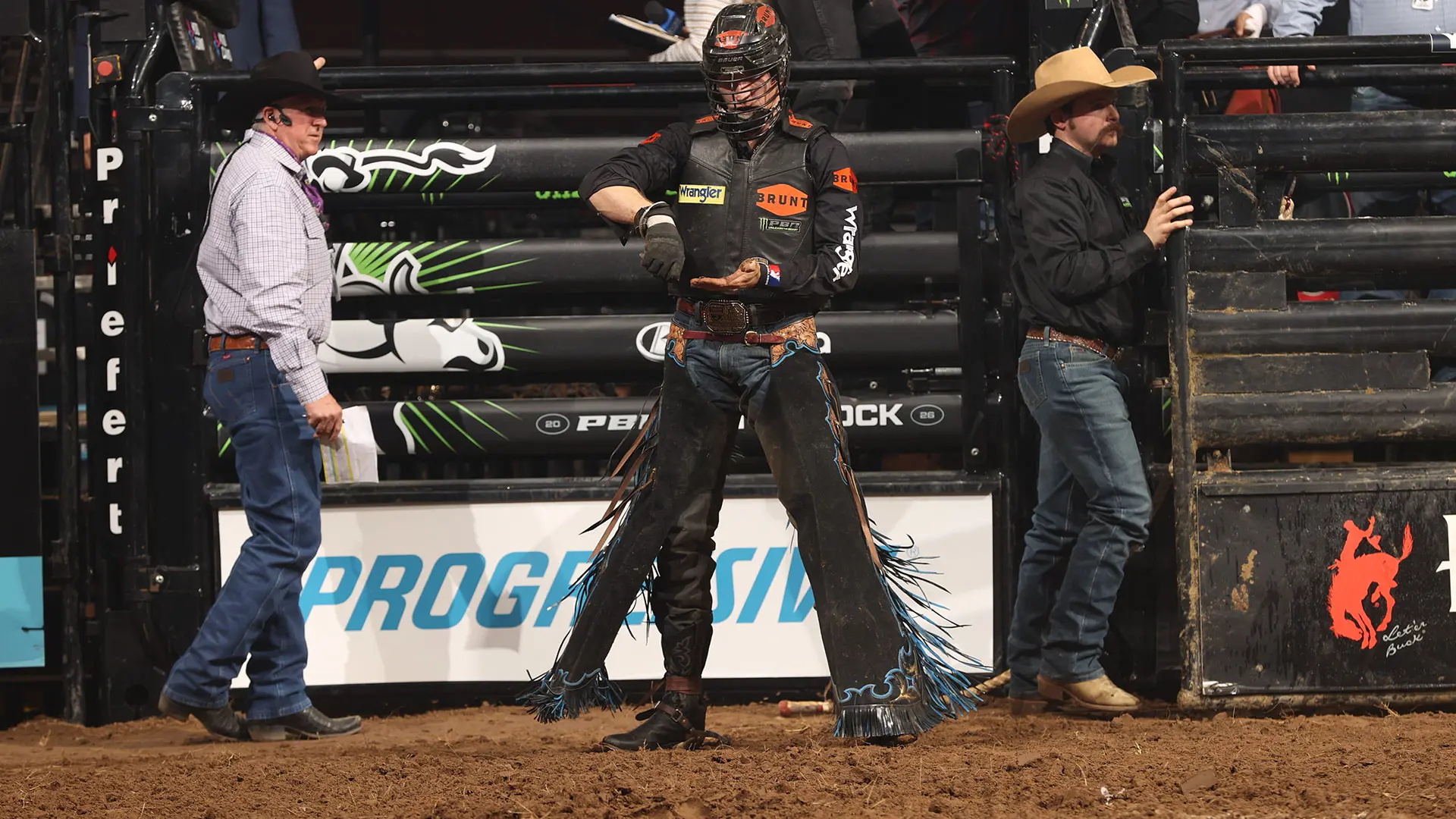
From scooter to big scores: Cort McFadden’s comeback
After a pulverized ankle sidelined him for months, Cort McFadden has battled his way back into the world title race—stronger, tougher and riding with more confidence than ever.
By Harper Lawson
Cort McFadden was never supposed to be just a bull getter onner...
Born into the sport, raised in it and shaped by it, the Novice, Texas, native grew up chasing buckles with dirt on his boots and a legacy already written into his name. The grandson of a rodeo hand and the son of four-time PBR World Finals qualifier Cory McFadden, bull riding wasn’t just something he did. It was in his blood.
But even for someone built for this life, the path to becoming a contender is never straight.
And sometimes, it breaks you before it builds you.
From the beginning, McFadden’s story was never rushed.
He didn’t climb on a full-grown bull until he was 14 years old. Not because he couldn’t—but because his dad wasn’t rushing him.
“But once I wanted to make that step,” Cort said, “my dad did everything he could to help me get to where I am.”
That patience turned into power.
By the time he joined PBR at 19, McFadden already carried himself like a veteran: calm, calculated, mature beyond his years. An old soul in a young man’s body—the kind of man who would jump out of a car on the freeway to help a stranger in a crash. The kind of rider who didn’t just ride for eight seconds—he hammered them.
It didn’t take long for the rest of the world to notice.
He burst onto the scene with authority, logging at the time a career-best 90-point ride on Ricky Vaughn and putting together a 13-for-29 rookie campaign that earned him the longest ride streak in Oklahoma Wildcatters history. By season’s end, he had climbed to No. 16 in the world.
Inside the locker room, teammates started calling him “The Texas Hammer.”
Or, based on the ride, some joked—“The Rubber Mallet.”
But the results weren’t a joke.
McFadden could ride the rank ones, and he proved it again and again—until the moment every rider faces but never sees coming, the one that tests whether you love this sport… or just the idea of it.
It came after a hard-fought 4.29 seconds aboard Socks in a Box and ended with something far worse than a zero. As the dust settled, the bull stepped on McFadden’s leg, leaving pieces of his ankle in all the wrong places: a broken tibia, a fractured fibula and torn ligaments holding the joint together—a classic high ankle sprain, only far more severe, the kind that sidelines football players like Brock Bowers and Tua Tagovailoa for entire seasons.
Eight screws. A “spiderweb” ankle. Months of rolling around on a scooter and showering with a plastic bag.
The repair was as gritty as the comeback. A long screw was placed to hold the torn ligaments in position, allowing them to heal back together. As strength and mobility returned, that screw eventually broke—by design—restoring just enough movement in the joint. The fixation helped accelerate the healing process, and because of it, he won’t need another surgery. It’s what allowed McFadden to get back to doing what he’s always done—pressing his cowboy boot into the dirt and turning his toes east and west.
For a young bull rider, it could have been the (ankle) screw in the coffin.
Instead, it became the (toe) turning point.
Injuries in bull riding don’t just attack the body.
They creep into the mind.
They sit in the quiet moments, asking questions no one wants to answer.
Will you ever be the same? Will you ever be as strong?
McFadden had those thoughts too.
“Yeah, there was a point where I thought that,” he admitted.
But instead of letting doubt take over, something else took hold.
It fired him up.
“I think it really brought me back to how much I love this sport and how much I wanted to come back and be successful.”
That mentality changed everything.
For the first time in his career, McFadden didn’t just work hard.
He worked out harder than he ever had before—dialing in rehab, building strength, sharpening agility and approaching every part of recovery with intention.
He attacked recovery the same way he attacked bulls—with purpose.
The comeback didn’t come easy.
It never does.
There were weeks on a scooter. Months away from competition. Hours spent rebuilding a leg that couldn’t even press flat onto the ground anymore.
But when he came back, he didn’t ease into it.
He showed up at Madison Square Garden.
Two and a half weeks of physical therapy. Two practice bulls. Then straight into one of the biggest stages in the sport.
And he rode.
Returning to New York—the same city where he broke his leg at Maverick Days during Teams—McFadden came back a new man, riding three bulls his first weekend back and finishing sixth.
“I want to be fighting for a world title,” McFadden said in New York. “I don’t want to be on the bubble anymore.”
That wasn’t just talk.
That was a promise.
Since returning, McFadden hasn’t just been keeping that promise.
He’s been dangerous.
In his last seven events, he’s finished inside the Top 10 five times, steadily clawing his way back into contention. His confidence has grown with every out and every ride.
In Pittsburgh, he delivered the best ride of his career—a 90.6-point performance aboard The Player.
Not just a career high.
A statement.
He isn’t just back.
He’s better.
Now sitting No. 9 in the world standings with a 51.61% riding percentage, McFadden is no longer chasing relevance.
He’s chasing a gold buckle.
“If I walk in there believing in myself that I can walk out with a gold buckle,” he said, “it’ll happen.”
That belief didn’t come from nowhere.
It came from the voice he’s carried his entire life.
His dad.
“Trust yourself. Believe in yourself.”
Simple words. Repeated over and over. Now embedded in everything he does.
When the chute cracks.
When the bull turns back.
When eight seconds feel like forever.
That voice is still there.
And now, so is the confidence.
Under the guidance of the Oklahoma Wildcatters previous head coach J.B. Mauney, McFadden has continued to evolve—not just as a rider, but as a competitor. He’s learned how to handle pressure, how to manage expectations and how to stay grounded in a sport that can take everything from you in an instant.
Off the dirt, he’s still the same.
Training his horses—Peanut, Yeller and Dollar. Golfing when he can. Grabbing sushi after rides. Living a life rooted in simplicity.
But inside the arena, there’s nothing simple about what he’s doing.
Because this version of Cort McFadden is different—stronger, more focused and more complete.
Bull riding doesn’t hand out second chances. You earn them through pain, setbacks and moments that make you question everything. McFadden has been through all of it, and now he’s riding with a clearer understanding of what it takes to compete at the highest level.
Next up is Albuquerque—three days and a significant opportunity to gain ground in the standings. He’ll open the weekend matched up against Ice Tray, another test as he continues his climb.
The Texas Hammer is back—not as a prospect, but as a contender who has already been tested and proven he can respond.
And if there’s one thing becoming clear, it’s this: a confident Cort McFadden is a dangerous one—and that may be the difference between chasing a gold buckle and winning one.