Flint Rasmussen’s lifetime of laughter lands him among PBR’s Heroes & Legends
From a kid in Choteau, Montana, to the man who redefined arena entertainment, Rasmussen will receive the Jim Shoulders Lifetime Achievement Award after building a legacy rooted in humor, connection and family.
By Harper Lawson
Before Flint Rasmussen became a PBR Heroes & Legends inductee, before he was selected to receive the Jim Shoulders Lifetime Achievement Award, before he was inducted into the National Rodeo Hall of Fame, before Madison Square Garden, AT&T Stadium, the PBR World Finals and the standing ovations, he was a kid from Choteau, Montana, riding his bike into town.
He did not grow up thinking he lived in a small town. It was just his town.
Choteau had the kind of childhood that now sounds almost fictional, or straight out of Little House on the Prairie: mountains, pastures, one-room schoolhouses, bikes leaned outside the pool, summer days that stretched from baseball practice to the ice cream parlor, and, of course, prairie and enough space for a kid’s imagination to run as far as his legs could take him.
For Rasmussen’s daughters, Shelby and Paige, that place is still central to understanding their dad.
They grew up 10 miles outside town, with one neighbor nearby, six kids across the way and the Rocky Mountain Front as their backyard. They ran through pastures, swam in the creek, fished, played hockey in the winter and knew everyone they passed in the grocery store.
“It was like very, very stereotypical, like Little House on the Prairie,” Shelby said.
For Flint, it was freedom.
His parents would leave for work, and by midmorning he would be on his bike, headed into Choteau to meet friends, swim, play ball, rehearse, sing, compete and do whatever else the town made possible for a kid willing to try everything.
He was an athlete, a singer, a performer, a student and, long before he had an arena microphone in his hand, the family entertainer.
His mother used to work for the town newspaper. To this day, even while living in Fort Worth, Texas, Rasmussen still gets the little Choteau paper mailed to him. His mom still makes sure of it.
That old paper, established in 1894, once documented the early version of the man Western sports would come to know. Family Christmas letters, laid out and printed by his mother, often carried some version of the same update: Flint was still keeping everybody entertained and laughing.
His father, rodeo announcer Stan Rasmussen, already knew what the rest of the world would eventually learn.
“You’ve entertained us forever,” Flint remembered his dad saying. “Why not in the arena?”
Before any national hall of fame, Rasmussen had already made the one at home.
At Choteau High School, his name went on the wall for the long jump record he set in 1986. Years later, the wall became something of a Rasmussen Hall of Fame. Paige joined him on the track record board. His daughter in her track uniform. Flint in his football uniform. Same school. Same wall. Same small-town pride.
He still holds the long jump record. At least for now.
There were kids who came close, he said. A few had potential.
But he isn’t nervous.
That is part of the Flint Rasmussen story, too. Long before he redefined rodeo entertainment, his roots taught him timing, toughness and presence. His father and brother were rodeo announcers. Summers were spent around arenas. He absorbed the rhythm of rodeo before he ever tried to make it his job.
“I knew timing,” he said. “I knew how to stay out of the way. I knew when not to talk and when to talk.”
At 19 years old, he put on greasepaint and worked his first rodeo in Superior, Montana.
At the time, it was supposed to be a summer job.
He was attending the University of Montana Western, where he studied history and math, and the rodeo clown work helped with college expenses. After graduation, he taught math and history in Havre, Montana, and coached football and track.
By 25, he left teaching and chose the arena full time.
He did not enter the sport with a grand plan.
“When I started doing being a rodeo clown or whatever, it was a summer job,” Rasmussen said. “It was just fun.”
That fun eventually became one of the most decorated careers in Western sports entertainment.
Rasmussen became an eight-time PRCA Clown of the Year, an eight-time Wrangler National Finals Rodeo barrelman and a seven-time Coors Man in the Can honoree. He worked major rodeos across the country before joining PBR full time, where he became the organization’s exclusive entertainer from 2006 to 2023 and performed at 26 PBR World Finals.
Now, in 2026, Rasmussen will be honored again — this time as part of PBR’s 28th Hall of Fame class during the Heroes & Legends Ceremony on July 30 at the National Cowboy & Western Heritage Museum in Oklahoma City.
Rasmussen will receive the Jim Shoulders Lifetime Achievement Award, which recognizes those who, throughout their life and professional career, have significantly contributed to the advancement of bull riding and rodeo. The honor comes two years after he was inducted into the National Rodeo Hall of Fame in 2024, further cementing a legacy built not on scores, buckles or qualified rides, but on connection.
For decades, Rasmussen did not ride the bulls.
He made people care about everything happening around them.
He made the in-between moments matter.
He turned commercial breaks, re-rides, delays and arena pauses into part of the show. He helped turn bull riding into a full-scale entertainment experience while never letting the Western lifestyle feel like a costume. He brought comedy, timing, music, dance, physical toughness, crowd work and improvisation into a role many had once viewed as secondary.
But Rasmussen’s impact was never limited to the crowd. He was part of the riders’ world, too, woven into some of the biggest and most personal moments of their careers. He danced with Paulo Crimber in the arena, then years later recreated that moment with his son, John Crimber, as another generation of bull riding history unfolded in front of him. He once carried Mauricio Gulla Moreira around the arena piggyback after a ride at the 2026 PBR World Finals, the kind of spontaneous moment that only happens when there is real trust between the entertainer and the athletes.
And even riders who have only been in PBR for a short time seem to understand what Rasmussen has meant to the sport. After big rides, Hudson Bolton, just two years into his PBR career, still finds Rasmussen among the first people to high-five.
By the time Rasmussen was finished, the entertainer was no longer a sideshow.
He was part of the production’s heartbeat.
The first National Finals Rodeo remains the moment that still sounds different when he talks about it.
The first night. Thomas & Mack Center. 1998.
He had grown up watching night one of the NFR on television in Montana, thinking it belonged to another world.
“It was untouchable,” he said.
Then came the phone call. After short lists and voting updates, Rasmussen simply received the call that he had made it. He went to his father’s real estate office in Choteau, told him the news, and the two walked half a block to the Legion Bar.
“That was cool,” Rasmussen said.
For eight straight years, the NFR became the biggest thing on his calendar.
Then PBR became the next challenge — or, shall we say, opportunity.
By the time Rasmussen moved exclusively into bull riding, he had already accomplished almost everything he could in rodeo. PBR offered bigger cities, bigger venues and a chance to reach fans who may have never considered themselves rodeo people.
Madison Square Garden. Los Angeles. Dallas. International arenas. Millions of fans.
His goal was not simply to be funny.
“I wanted to make a difference in front of people that wouldn’t normally go to a rodeo,” Rasmussen said.
Rasmussen was never just a clown in the traditional sense. He combined stand-up comedy, improv, dance, music, physical comedy, crowd work, commentary and instinct. He could fill four minutes of dead time like it was scripted, even when none of it was. He could spot one fan in the upper deck and build a bit around them without making them feel small. He could read a room of 15,000 people and still make the person he was joking with feel like they were in on it.
That mattered to him.
If he poked fun at someone, he made sure they were part of the moment, not the punchline.
“I included them,” he said. “You’re just trying to make them feel a part of things.”
His daughters understood early that the job was not just goofing around.
People always asked if their dad was like that at home.
The answer was no.
Not exactly.
The arena version of Flint was real, but it was amplified. Faster. Louder. Sharper. His brain processing constantly, scanning the crowd, the dirt, the riders, the production cues, the pauses, the wrecks, the recovery time and the next opening.
At home, he was still funny. But he was also serious, emotional in quieter ways, hard on himself and deeply committed to getting the work right.
“He cares about this so much that he wants to perfect his craft,” Shelby said.
That perfectionism extended even to the makeup.
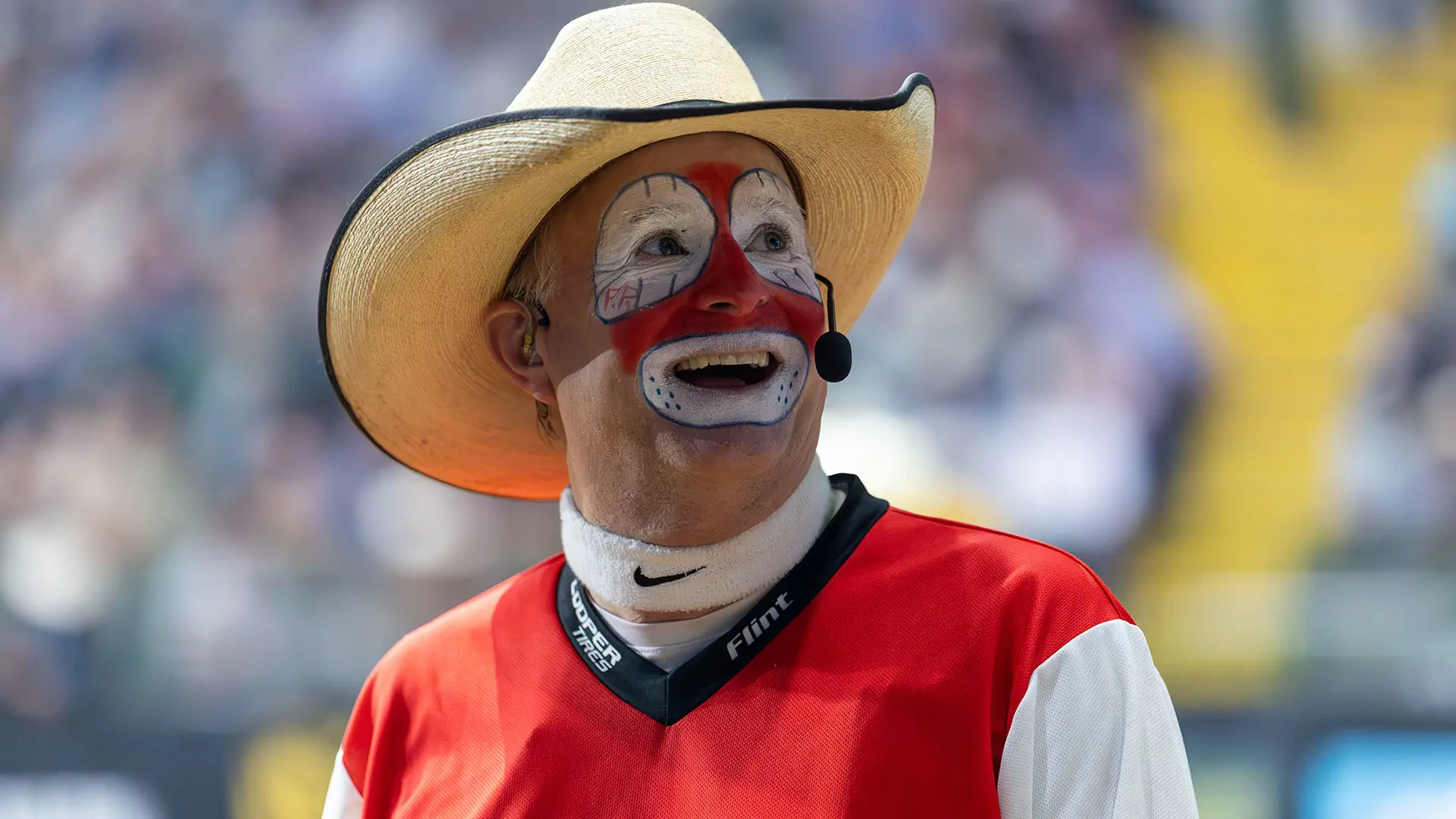
Rasmussen’s face became one of the most recognizable in Western sports, but the routine behind it was practical, precise and almost automatic. Right eye first. Then the mouth. Then the left eye. Same lines. Same order. Same muscle memory.
When he made a surprise return at Madison Square Garden after more than two years without putting the makeup on, he pulled out the mirror and the routine came right back.
By then, the makeup carried history.
It carried the small rodeos in Montana, the National Finals Rodeo, the PBR World Finals, the cities, the countries, the laughs, the injuries, the fatigue and the years spent being “on” for everyone else.
It also carried sacrifice.
Rasmussen is honest about that part now.
The career gave him almost everything. It also took pieces of him. Time away from home. Missed moments. Physical wear. Emotional exhaustion. A body that eventually told him the job could not keep going the way it had.
His daughters saw both sides.
When they were little, rodeo was a family life. Summers were spent in a motor home, going from one rodeo to the next. Cheyenne. Pendleton. Major stops. Announcers’ kids were almost siblings. A traveling community.
When Rasmussen went exclusively to PBR, the rhythm changed. He flew out on weekends. The girls stayed home more, started rodeoing themselves, went to school and built their own lives.
Their mother hauled them to rodeos. Flint made what he could. He was there for Paige’s track meets when possible. He coached when he could. But high school rodeo happened on weekends, the same time PBR happened on weekends, and the conflict was constant.
Shelby and Paige understand it more now.
“I think we’ve all learned from that,” Paige said.
The relationship between Flint and his daughters has grown deeper with time. Today, both girls live in Texas. Not because they followed him exactly, but because life and work brought them there. Now they see him more than they ever did when they were younger.
They have a Snapchat group chat called “Jonas Brothers.”
The name started as a strategic reminder to get concert tickets. It worked. The name stuck.
Now it is just the three of them sending reels, jokes and pieces of their days back and forth.
They sing in the car. Not casually. With Flint, even a car song can become a production. He assigns parts. First verse. Second verse. Chorus. Harmony.
They talk about work, creativity, writing, relationships and life.
He calls. They call. Sometimes several times a day.
For all the arenas he has commanded, for all the fans he has made laugh, for all the halls of fame and honors, the easiest way to understand Flint Rasmussen is still to watch him talk about his daughters.
Ask him what he is most proud of in life, and the entertainer fades.
The dad answers.
“My two girls,” he said.
He will tell you they are smart, strong, active, independent and solid. He will tell you they have been through a lot and came out the other side well. He will tell you they are his greatest pride before he says a word about Madison Square Garden, the NFR, PBR or any award.
Behind his desk, surrounded by PBR and rodeo memorabilia, there is a picture from the Tucson Rodeo in 2002.
Flint is there with Shelby and Paige when they were little. Paige was not yet a year old. Shelby was almost 3. The girls are small enough that the photo feels like a lifetime ago, but it has its own place in his office.
In the middle of a career shrine, there is a dad’s favorite picture.
His daughters are his life’s work.
What he did with the rest of his life is remarkable, too.
In 2023, Rasmussen stepped away from his full-time on-the-dirt PBR entertainer role. At the time, his knees hurt, his body hurt and, more than anything, his heart and mind were tired.
He was burned out.
“I was not finding things funny anymore,” he said.
For a man whose gift was bringing joy to others, that was the signal.
He retired from the arena, moved into broadcasting and corporate work, and now serves as PBR’s SVP of Fan Engagement and Head of Competition. But retirement was never really retirement.
His daughters call it a next chapter.
He has returned for select arena appearances, including at the 2026 PBR World Finals, and those cameos have reminded him of something he had been missing. He compares it to a musician who stops touring but still needs to sing.
“When I quit touring, it was like I was a musician, and somebody took my guitar away,” Rasmussen said.
The first surprise appearances fed something in him again. They created moments for the crowd, but they also gave something back to the man who had spent most of his adult life creating moments for everyone else.
Still, he is careful.
He does not want to hurt again. He does not want to go back to the place where the job feels heavy instead of joyful. He knows what it took to be Flint Rasmussen at full speed.
So do his daughters.
When they watch him now, they do not only think about what the crowd sees. They think about what it gives back to him.
“There was something missing,” Shelby said.
That is what makes the Jim Shoulders Lifetime Achievement Award fit.
The honor is not simply about longevity. It is about advancement. It is about changing bull riding and rodeo in a way that lasts beyond a single season, a single performance or a single arena.
Rasmussen did that.
He raised the standard for what arena entertainment could be. He turned the role into something smarter, sharper and more emotionally connected. He helped make the fan experience feel alive from the first out to the last. He gave bull riding a bridge between sport and showmanship without ever letting either side feel less authentic.
He made Western sports bigger without making them feel less Western.
For more than three decades, Rasmussen gave the sport something it did not have before him. He made new fans feel welcome and old fans feel seen. He brought city crowds into a Western world he still believes is worth protecting. He helped carry a lifestyle into places where many people’s closest connection to the West came from television.
He has always understood that part of the job.
He is not only an entertainer. He is an advocate for where he came from.
Choteau is still with him. Montana is still with him. The old railroad track behind the house, the high school record board, the town paper, the family, the rodeo summers, the little roads and big skies — all of it remains part of the act, even when the act is no longer full time.
He lives in Texas now.
He can appreciate a warm night when it is still 82 degrees at midnight. He can even joke about DFW traffic, though, like any Montanan, he does not exactly enjoy it.
But he still reads the Choteau paper.
He still talks about home like it made him.
Because it did.
Before the awards, before the arenas, before the National Rodeo Hall of Fame, before PBR’s Heroes & Legends Ceremony, Flint Rasmussen was a kid from Montana who could make people laugh.
Then he spent the rest of his life proving just how far that could take him.
And when he is honored July 30 in Oklahoma City, it will not just be for the jokes, the dancing, the makeup, the music or the millions of fans he entertained.
It will be for what he built.
A role. A standard. A connection. A legacy.
And when he looks back at all of it — the rodeos, the PBR, the records, the stages, the laughs, the pain, the pride, the mistakes, the gratitude — the answer still comes back to the two girls in the picture behind his desk.
The rest of the world knows Flint Rasmussen as a rodeo icon.
At his core, he is simply Shelby and Paige’s dad.
And that, more than anything, is the role he is proudest to have played.