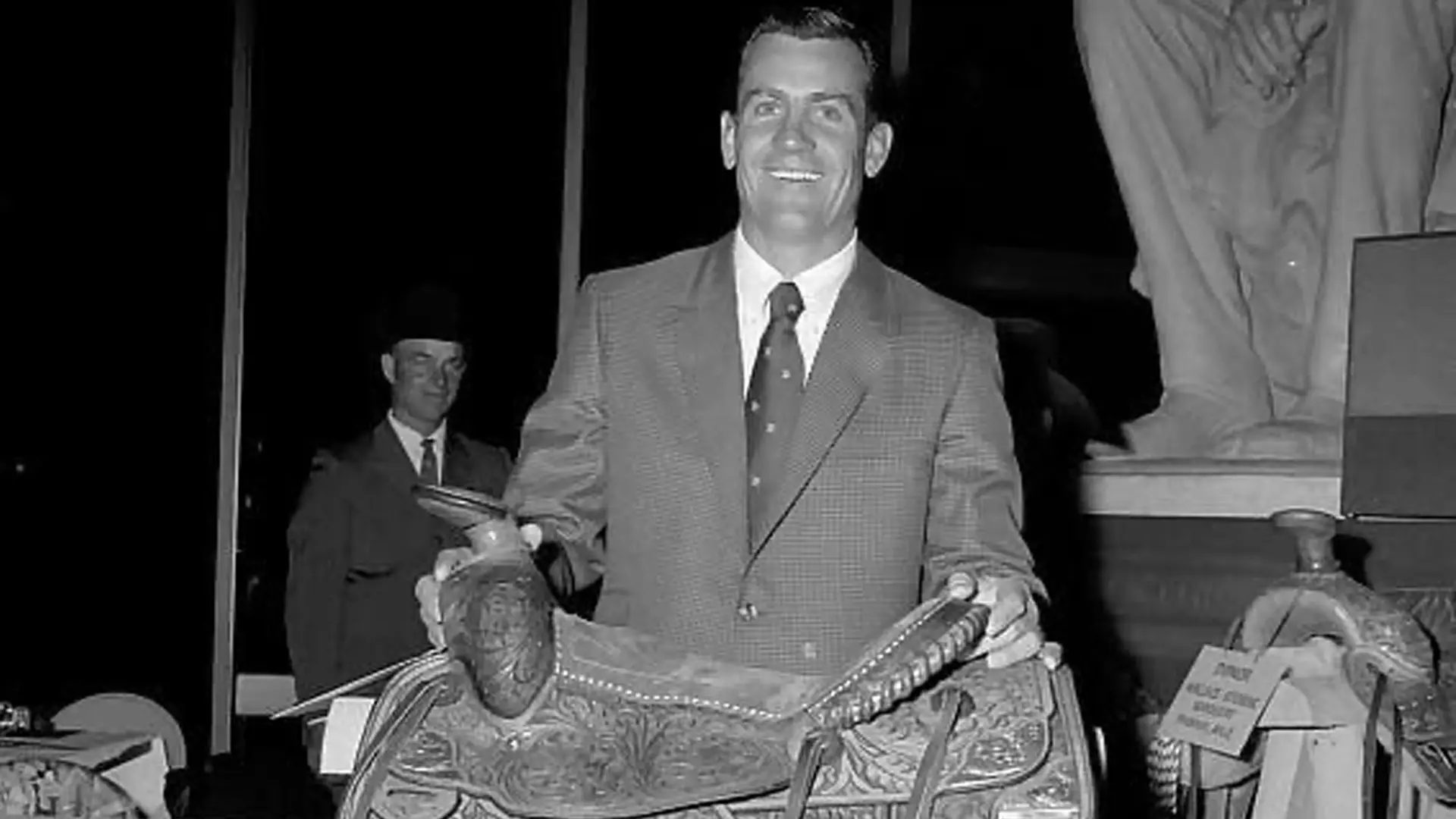
Before Dean Oliver became an 11-time world champion, before eight tie-down roping gold buckles, three consecutive All-Around World Championships and a place among the greatest cowboys in rodeo history, he was a broke teenager standing outside the rodeo grounds in Nampa, Idaho.
He had never grown up around horses.
His family could not afford to attend the nearby Snake River Stampede.
But one summer night, Oliver and his brother, Dale, found their way inside.
What Oliver saw changed his life.
A small cowboy wearing glasses roped a calf in a matter of seconds and won $300.

For a teenager who had grown up hungry, wearing secondhand clothes and working farm jobs for little more than room, board and a few dollars a month, it looked like a fortune.
“I watched a little guy wearing glasses win $300 in calf roping,” Oliver later recalled. “That seemed like $3,000 to me sitting there broke and hungry and wearing secondhand clothes. I figured, if that little guy could do it, so could I.”
That was the beginning.
Not of an easy path.
Not of instant success.
But of one of the greatest careers professional rodeo has ever seen.
Oliver, born Dennis Dean Oliver on Nov. 17, 1929, in Dodge City, Kansas, entered the world with the odds already stacked against him. The fifth of seven children born to Vesper and Vernon Oliver, he was what was then commonly called a “blue baby,” born with Rh-negative blood.
As a child, he was frail and struggled with breathing problems during strenuous activity. His mother took him to a doctor and was told he had a bad heart. He was put on a special diet and instructed to avoid heavy activity.
Life had other plans.
Oliver’s father was killed in a plane crash, leaving his mother to raise seven children alone. The family relied on welfare to survive. Oliver remembered wearing ill-fitting clothes from the Salvation Army and the embarrassment of facing other children at school in hand-me-downs.
School never held his attention.
His mind was somewhere else.
Oliver would stare out the classroom window and imagine himself as a cowboy, working cattle on a ranch and living the kind of open, unconfined life he had not yet experienced.
He quit school in the ninth grade to help support his family.
At 15, he went to work on a farm near what would later become Karcher Mall in Nampa, Idaho. He milked cows, hauled hay and handled general farm work for $15 a month, plus room and board.
He was not yet a cowboy. He was not yet a roper. He had barely been around horses.
But after watching the cowboys exercising their horses at the Nampa rodeo grounds and then sneaking into the rodeo that night, he could not shake what he had seen.
The horses. The hats. The boots.
The freedom.
And, especially, the $300.
“You can’t imagine how appealing that life seemed to me,” Oliver recalled. “I was in awe of the cowboys and the free, unconfined life they led.”
The dream stayed with him.
In 1947, while hoeing and topping beets in Nampa, Oliver met Martha Reisenstein. The two married in February 1950.
By then, Oliver had decided he was going to become a rodeo cowboy.
The problem was that he still did not really know how.
Martha had saved $11 in tips from working at a drive-in. Around that time, Oliver bought a green, untrained horse for $400 after being told he could turn it into a rope horse.
He believed them.
At the time, Oliver was picking up ropes and throwing loops at fence posts. Someone had shown him how to tie a calf, but he had little practical experience and no money to buy livestock to practice on.
Eventually, he bought one calf for $10.
There were no proper pens.
No practice chute.
No sophisticated training setup.
Martha would hold the calf until Oliver was ready, then turn it loose.
Oliver would rope it, get off his horse and attempt to make the tie while the inexperienced horse circled around him.
It was not exactly a blueprint for becoming the greatest tie-down roper of a generation.
But Oliver kept working.
He practiced after full days on the job.
He practiced in the dark.
He and his family made sacrifices just to afford the horse and the single practice calf that gave him a chance to learn.
At times, those sacrifices included going hungry.
Oliver was still working at a dairy for $165 a month when he won the calf roping at a rodeo in Kuna, Idaho.
Driving home afterward, he began to believe the dream might actually be possible.
He told his boss he was thinking about quitting because he was starting to win money roping.
His boss offered him a raise.
Oliver stayed another month.
His next paycheck was $170.
Five dollars more.
He quit.
As Oliver walked away, his angry boss left him with a parting shot.
“What makes you think you can be a rodeo star?” the man asked. “You can’t even walk a straight line.”
Oliver never looked back.
His first professional rodeo was in Jerome, Idaho.
He won.
Then he traveled to Albuquerque, New Mexico, where many of the sport’s top professional ropers were competing.
Oliver finished second.
That was enough.
He knew he could compete with the best.
By then, he had given up on trying to turn his original green horse into a finished rope horse. Instead, he rode experienced borrowed horses and gave their owners a quarter of his winnings.
The money was still not easy.
Neither was the rodeo road.
But the results started coming.
Oliver spent the winter of 1953-54 living at the Texas ranch of another calf roper, an experience that helped accelerate his development. In 1954, he finished third in the Rodeo Cowboys Association standings with a little more than $11,000 in season earnings.
After expenses, he figured he was slightly ahead.
One year later, everything changed.
At the end of the 1955 season, Oliver had won $19,963 and his first World Championship in calf roping.
The lanky 6-foot-3, 200-pound cowboy from Idaho had done what many in rodeo had not expected.
He had beaten the traditionally dominant Southern ropers for the world title.
The kid who once could not afford to attend the Snake River Stampede was now the best in the world.
But he was only getting started.
Oliver would go on to win eight world championships in tie-down roping, capturing titles in 1955, 1958, 1960, 1961, 1962, 1963, 1964 and 1969.
His eight tie-down roping world titles became the standard for the event and still stand as the record, later equaled by Roy Cooper.
Between his first championship and his last, Oliver dominated his era with a combination of size, speed and smooth coordination.
They called him “The Wope.”
And in the 1960s, nobody was faster.
Oliver won five consecutive tie-down roping world titles from 1960 through 1964. He also expanded beyond his signature event, using his ability in steer wrestling to become one of rodeo’s greatest all-around cowboys.
The idea began with $47.
In 1961, Oliver entered the steer wrestling at a rodeo and won just $47.
It was not much money.
But it put him second in the world all-around standings and showed him what was possible.
To win the All-Around World Championship, a cowboy had to earn money in multiple events. Oliver realized that if he could supplement his tie-down roping winnings with enough money in steer wrestling, another gold buckle was within reach.
In 1963, he won approximately $3,000 in steer wrestling and $28,375 in calf roping.
It was enough to win his first All-Around World Championship.
Then he did it again.
And again.
Oliver won three consecutive All-Around World Championships in 1963, 1964 and 1965, bringing his career total to 11 world titles.
His dominance stretched from the regular season to rodeo’s biggest stages.
Oliver qualified for the National Finals Rodeo 18 times.
He roped at the first NFR and returned for his final qualification in 1976, creating a remarkable connection between the event’s earliest years and the generations that followed.
He won the NFR tie-down roping average in 1961 and the NFR all-around average in 1966.
He competed across decades.
And he kept winning.
At the center of some of Oliver’s greatest years was a little sorrel gelding named Mickey.
In 1959, Oliver flew to Texas to enter rodeos and borrowed the 11-year-old horse from fellow roper Lee Cockrell.
Mickey fit him.
Oliver began winning.
Cockrell eventually agreed to sell him the horse, and from May to November alone, Oliver won $18,500 aboard him.
The following season, Oliver won his third tie-down roping world title.
Mickey helped carry him through the historic run that followed.
Then, in 1964, a freak accident changed everything.
Oliver had traveled to New York to film a television commercial and turned Mickey out to pasture while he was away. When Oliver returned home, he walked to the fence to see him.
Mickey ran toward him, feeling good, then turned, kicked up his heels and ran away.
Somewhere in the movement, he injured his stifle.
He was never able to return sound enough to haul again.
“I can easily say today that was one of the biggest losses of my life,” Oliver said.
Still, Oliver kept going.
By 1964, he had won his seventh world tie-down roping title.
He would eventually add the elusive eighth.
But it would not come easily.
Oliver might have won a ninth world championship had two catch ropes not broken at the 1966 National Finals Rodeo.
Instead, the eighth arrived three years later.
In 1969, Oliver returned to the top of the world standings, winning his eighth tie-down roping championship and setting a new single-event season earnings record with $38,118.
At the time, world champions were averaging roughly $24,000 in a winning season.
Oliver had reset the standard.
Again.
That same year, he won some of rodeo’s most prestigious events, including the tie-down roping titles at Cheyenne Frontier Days and California Rodeo Salinas.
But naming only a few major victories hardly captures the scope of Oliver’s career.
He won virtually everywhere.
Cheyenne, Salinas, Fort Worth, Denver, Pendleton, Reno, San Antonio, Cody, Ellensburg, Ogden, Red Bluff, Deadwood and Clovis.
And again and again at the Snake River Stampede, the rodeo he had once been too poor to attend.
Oliver won the tie-down roping there 10 times.
He also won the Caldwell Night Rodeo championship eight times.
At Ellensburg, he won in 1962, 1963, 1964 and again in 1971.
At Ogden Pioneer Days, he won five times.
At the Cody Stampede, he won three times.
At Cheyenne Frontier Days, he captured titles in 1969 and 1974.
At the Pendleton Round-Up, he won in 1957, 1971 and 1976.
At the Reno Rodeo, he won in 1961, 1971 and 1974.
The years attached to those victories tell their own story.
Oliver did not dominate for a season or two.
He endured.
His career stretched from the formative years of professional rodeo well into the 1970s. He continued to compete into his 40s and, in 1979, when he was inducted into the ProRodeo Hall of Fame as part of its early class of honorees, he was still roping and still winning.
The cowboy who had once been told he could not even walk a straight line had become one of the finest athletes rodeo had ever seen.
And rodeo was not the only place he could compete.
Oliver also made his mark on the golf course, winning the Idaho Open in 1973.
The accomplishment might seem unexpected until considering the athlete behind it.
Rodeo had already shown what Oliver could do with timing, coordination, focus and competitive drive.
Golf simply gave him another place to use them.
Yet even 11 world championships do not tell the entire Dean Oliver story.
Neither do the 18 NFR qualifications.
Neither do the major rodeo victories, earnings records or Hall of Fame inductions.
Oliver also gave back to the sport that had changed his life.
During his competitive career, he served multiple terms on the board of directors of the professional rodeo association, helping shape the sport from behind the scenes as well as inside the arena.
Long after his own championship years ended, Oliver remained connected to the rodeo world.
Nearly nine decades into his life, he was still working behind the scenes at the NFR.
The teenager who once snuck into a rodeo because he could not afford a ticket had become part of the foundation of the sport itself.
His influence has been recognized across rodeo and throughout the West.
Oliver was inducted into the National Rodeo Hall of Fame in 1963 and the ProRodeo Hall of Fame in 1979. His name also entered the Idaho Hall of Fame, Idaho Athletic Hall of Fame, Pendleton Round-Up Hall of Fame, Ellensburg Rodeo Hall of Fame and St. Paul Rodeo Hall of Fame.
In 2012, he was named a Legend of ProRodeo.
His story has even appeared in Idaho history books.
None of that was the goal.
When Oliver first decided to become a calf roper, he was not thinking about setting records.
He was not planning on winning 11 world championships.
He was not dreaming about seven Hall of Fame inductions or becoming the standard against which future tie-down ropers would be measured.
His goals were considerably simpler.
Earn a living.
Buy a place of his own.
Everything else, as Oliver saw it, was gravy.
That perspective may explain one of the more revealing details about him.
After all the gold buckles, championships and history, Oliver once listed winning his sixth-grade marble championship in the Nampa schools among the five greatest accomplishments of his life.
At that moment, for that boy, it mattered.
Long before the rodeo world knew his name, he knew what it felt like to win something.
Perhaps that is the thread running through all of it.
Oliver never began with much.
He simply kept building.
One rope. One calf. One horse. One rodeo at a time.
That legacy now adds another honor.
Oliver is one of two distinctive athletes being honored with the Ty Murray Top Hand Award, created in 2018 and presented annually to individuals who, through their own efforts, have made significant and lasting contributions to enhance the sport of rodeo.
Rooted in traditional American values and fundamental ideals including courage, pride, respect and hard work, the award recognizes individuals whose championship characteristics and contributions help protect and advance rodeo’s heritage for generations to come.
Few careers embody those ideals more completely than Oliver’s.
His eight world tie-down roping championships remain the benchmark in the event.
His three consecutive All-Around World Championships proved the breadth of his ability.
His 18 NFR qualifications connected multiple eras of professional rodeo.
His work as a director helped serve the cowboys competing alongside him.
And his longevity in the sport ensured that his contribution did not stop when he backed into the box for the final time.
For Oliver, rodeo began with the sight of one cowboy earning $300 in a few seconds.
By the time he was finished, the boy who had simply wanted to earn a living had done something far greater.
Dean Oliver remains one of the cowboys who helped define rodeo.
And all these years later, it is still the reason she rides.