PBR may leave Oklahoma City, but fans can experience it year-round at the Heroes & Legends Hall of Fame
The new PBR Heroes & Legends Hall of Fame at the National Cowboy & Western Heritage Museum gives fans a year-round home for the sport’s history, artifacts and defining moments.
By Harper Lawson
The 2026 PBR Teams season marked five years of team bull riding, and once again, the league rolled into Oklahoma City for Wildcatter Days and its annual Heroes & Legends celebration.
But this time, PBR left something behind.
Long after the big red trucks packed up outside Paycom Center, the bulls were loaded and the Teams season moved on to its next stop, but a piece of PBR remained in Oklahoma City — one fans can experience all year long, even when the cowboys of PBR are miles away.
The PBR Heroes & Legends Hall of Fame now has a permanent home inside the National Cowboy & Western Heritage Museum.
There are championship buckles, bull ropes and pieces of protective equipment. There are videos of rides that helped define eras, artifacts from world champions and displays documenting the evolution of a sport that began with 20 bull riders betting on themselves.
There is also a scoreboard, the shark cage and even the unmistakable burst of PBR pyro — close enough to remind visitors that sitting too close to the pyro at a PBR event is one good way to leave with fewer eyebrows than you came in with.
And among everything now housed inside the Hall at the National Cowboy & Western Heritage Museum, one of the most significant pieces is remarkably simple.
A canceled $1,000 check.
Written by the soft-spoken but undeniably badass Michael Gaffney in 1992, it represents his investment as one of PBR’s 20 founders and the beginning of what would grow into a global professional sport.
“To most people, it’s just a canceled check,” PBR CEO Sean Gleason said. “To us, it’s the receipt for one of the boldest bets ever made in Western sports.”
That check now has a permanent home.
On July 30, PBR formally unveiled the expanded PBR Heroes & Legends Hall of Fame inside the National Cowboy & Western Heritage Museum, establishing a physical place dedicated to preserving the people, animal athletes, moments and innovations that shaped the organization.
For Gleason, the setting was as important as the collection itself.
“I can’t think of any place in the world more fitting than the National Cowboy & Western Heritage Museum to preserve the story of our sport,” he said. “This museum has long been entrusted with telling the story of the American West — its grit, its courage, its innovation. We’re proud PBR has a permanent home alongside that legacy.”
The partnership was years in the making.
According to The Oklahoman, conversations between PBR and the museum began seven years ago. PBR had considered multiple locations, including the possibility of a standalone Hall of Fame, before Gleason approached the National Cowboy & Western Heritage Museum.
“I don’t think we want our own,” Gleason said. “I think we want to be part of this.”
The result is a Hall of Fame that places PBR’s history within the broader story of Western sports while also documenting a sport still actively creating its next chapter.
Jeff Ewing, executive vice president and chief development officer of the National Cowboy & Western Heritage Museum, described PBR as an essential part of the museum’s larger effort to reimagine how rodeo and Western sports are presented.
“We are reimagining rodeo storytelling and our western sports storytelling,” Ewing said. “PBR is one facet of the overall renovation. We will highlight the story of rodeo from its origins to today. You can’t tell that story without having the PBR.”
More than memorabilia
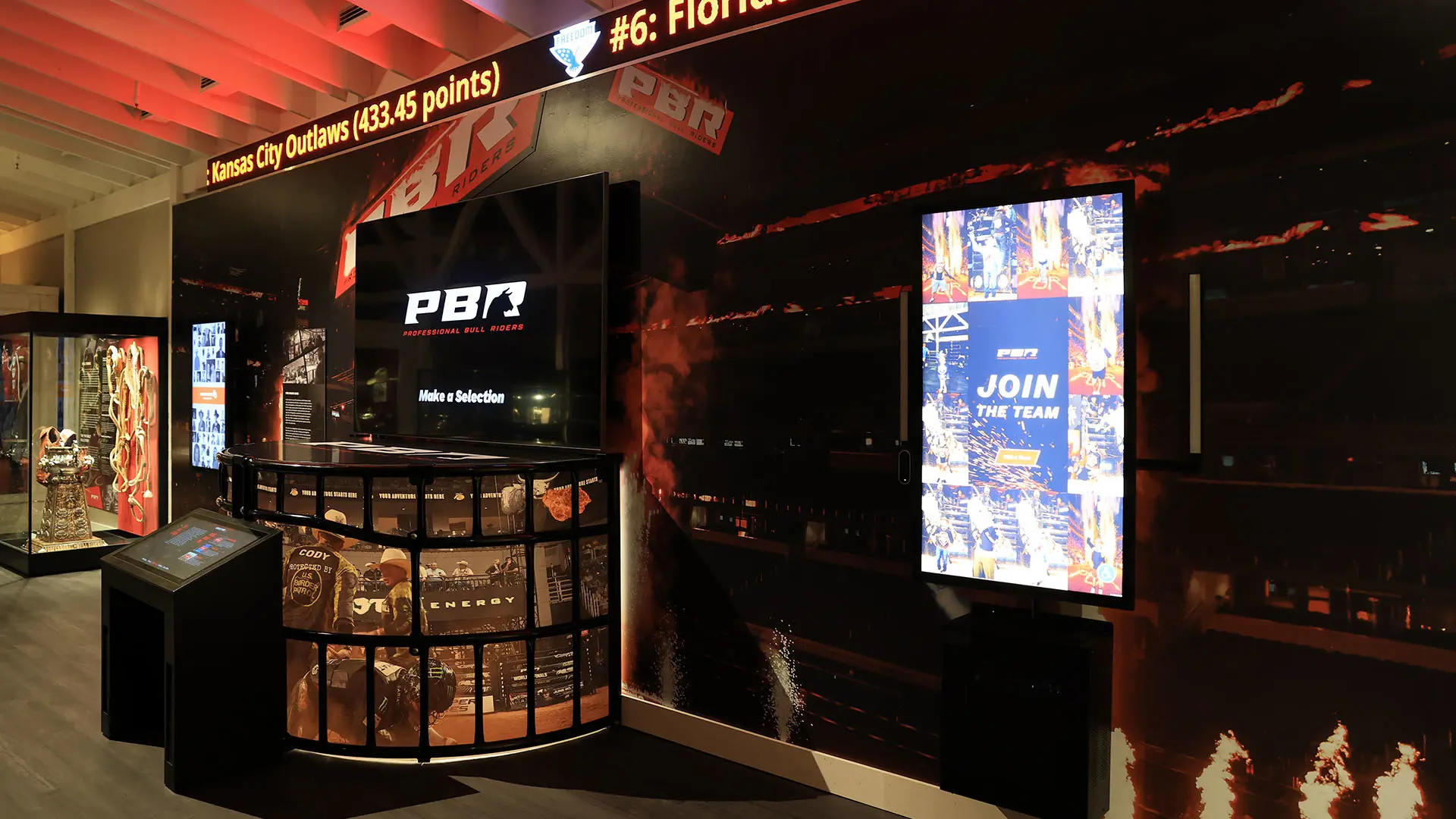
Walking through the PBR Heroes & Legends Hall of Fame feels less like moving past a series of museum cases and more like moving through pieces of an event night.
The details are everywhere.
There is the scoreboard. There is the shark cage. There is PBR pyro bringing some of the sensory experience of an arena into the museum — minus, ideally, any actual eyebrow casualties.
Then there are the pieces that allow visitors to dig deeper into the sport itself.
A centerpiece interactive allows visitors to watch some of the greatest rides in PBR history — the same rides today’s cowboys have sat together and watched in the Nashville Stampede locker room, pulled up on an iPhone rolling down the road or still remember seeing for the first time as kids dreaming of making those rides themselves.
Alongside that history, additional displays keep the Hall connected to the PBR of today with current PBR Teams scores and standings.
The “Join the Team” augmented reality experience lets visitors virtually wear the jersey of their favorite PBR team and a cowboy hat before creating an image they can download and share — so even the smallest kid can feel 10 feet tall, like John Crimber when he won back-to-back PBR Teams MVP titles in 2024 and 2025. An LED ticker above the experience also displays current scores and standings.
Together, the features make the Hall feel active rather than frozen in time. A visitor can move from the sights and sounds associated with a PBR event to the equipment, trophies and artifacts that explain how the sport reached this point.
There are pieces documenting how rider safety evolved, along with two former championship trophies — the Bud Light Cup and Jerome Robinson Cup.
For Oklahoma Wildcatters rider Cort McFadden, one piece of equipment immediately stood out: an early protective vest connected to the changes that followed Lane Frost’s death.
“When Lane Frost died, he came up with that idea. The vest,” McFadden told KFOR. “And everybody wears — well, now it’s a requirement, and it’s pretty cool to see the first one ever built.”
And that might be the best way to describe the entire space: a museum cowboys can get behind — the Smithsonian of bull riding, if you will.
Another display creates a timeline using generations of bull ropes, including Gaffney’s rope alongside one belonging to legendary rodeo figure Jim Shoulders.
“A reminder that every generation builds on the shoulders of those who came before,” Gleason said.
The Hall also features the 2026 PBR World Championship buckle, which flew aboard the Bullfrog 001 rocket mission in the Mojave Desert through a partnership with the U.S. Space Force.
The buckle survived the landing, though it proved slightly less cowboy tough under gravity than the man who ultimately got to wear it.
“That buckle is incredible because everything else that was in that payload was burned or destroyed because there was a significant fire attached to the landing,” Gleason told KFOR.
Where PBR began
Still, the founding check remains one of the clearest links to PBR’s origin.
In 1992, 20 bull riders each invested $1,000 to create what became Professional Bull Riders.
“That check is the Day 1 of everything that we have now,” PBR announcer Matt West told The Oklahoman.
Gleason used the artifact to recognize both Gaffney and the other founders whose willingness to invest in their sport created opportunities for generations that followed.
“Michael and 19 other riders believed the sport they loved could become something greater,” Gleason said. “They were willing to bet on themselves, and because they did, PBR is a global sport enjoyed by millions.”
For Gaffney, the Hall of Fame represents something the founders did not have when PBR began — a permanent place where the people who built the sport can be recognized.
“For us to have our own home and to celebrate the guys that do it and love to do it, and they really care about what they do, is special to me,” Gaffney told KFOR.
History that is still being written
The Hall of Fame does not stop with PBR’s founding generation.
Artifacts from 2022 PBR World Champion Daylon Swearingen are included alongside pieces from earlier eras, intentionally connecting what PBR has been with what it continues to become.
“The Hall of Fame isn’t just about where we’ve been — it’s about where we’re going,” Gleason said. “He represents a new generation of world champions who continue to elevate this sport with remarkable talent, resilience, and professionalism.”
For Swearingen, who visited the museum as a child, being represented inside it carried its own significance.
“I came here when I was younger, and I remember walking around this place. We spent the whole day here,” Swearingen told the Norman Transcript. “Now it’s cool that we have a home here.”
And for the riders who come after him, he believes the Hall can provide something even more important: an example.
“Bull riders can come here and see who they want to become,” Swearingen said. “I want to be in the same place as Michael Gaffney, Silvano Alves and all the greats who paved the way before me.”
That connection between generations was central to the Hall’s opening.
The new installation debuted alongside PBR’s annual Heroes & Legends Celebration, where Silvano Alves and George Paul were recognized with the Ring of Honor; Flint Rasmussen received the Jim Shoulders Lifetime Achievement Award; Elsie Frost received the Sharon Shoulders Award; and Charmayne James and Dean Oliver were recognized with the Ty Murray Top Hand Award. Legendary bovine athlete 102 Promiseland was also honored.
The yearly Heroes & Legends celebration takes place inside the National Cowboy & Western Heritage Museum, where breathtaking Western landscape portraits line the walls and give the night a setting every bit as grand as the legacies being honored.
“Heroes & Legends is not just a ceremony or celebration of championships and buckle counts,” Gleason said during the event. “This night is about preserving the legacy of the people and animal athletes who have built PBR, elevated us, and inspired generations to dream bigger.”
A permanent place in Western history
The PBR Heroes & Legends Hall of Fame is distinct from the National Rodeo Hall of Fame, which is scheduled to open its renovated exhibition in November. The “World of Rodeo” is one installation planned within that National Rodeo Hall of Fame space rather than a name for the entire museum area.
Together, the projects are part of the National Cowboy & Western Heritage Museum’s broader effort to preserve and present Western sports history.
For PBR, the new Hall gives the organization something it had never previously possessed: a permanent physical home for its history.
West, who grew up visiting the museum from his hometown in northeastern Oklahoma, described the opening as a full-circle moment.
“Today is a historic day for us,” he said, “to be able to put these artifacts and names in a place where they get the respect and prestige they deserve.”
The founding check is there. So are the championship trophies and bull ropes. Visitors can learn how protective equipment evolved, pull up legendary rides, follow current Teams standings and see artifacts from both the pioneers who created PBR and the riders still writing its history.
And as Gleason emphasized throughout the opening, the Hall is not intended to freeze PBR in the past.
It is meant to preserve the foundation while leaving room for everything still to come — with future Hall of Famers climbing into the chutes all season long and legendary bulls waiting underneath them, ready to give those riders the opportunity to do something great enough to one day earn a place on these walls.
Thanks to the partnership with the National Cowboy & Western Heritage Museum, when those careers become history, their stories will have somewhere to go.
“Our responsibility isn’t simply to remember our history,” Gleason said. “It’s to preserve it, share it, and continue writing it.”