The Bull Rider Development Model (BRDM) is a nationwide framework designed to help riders develop the right way — safely, progressively, and with long-term success in mind.
Built from principles of long-term athlete development, modern sports science, and proven athlete development systems used across elite sports, the BRDM provides a roadmap for riders, parents, coaches, and organizations to guide athlete growth from the first practice ride through the professional ranks. The model emphasizes age-appropriate training, quality coaching, mental toughness, physical preparation, and consistent skill progression — not just riding more bulls.
For years, many riders developed through a “learn by surviving” approach:
While toughness and the cowboy way will always be part of bull riding, the modern athlete requires more than courage alone. Today’s elite riders are skilled movers, explosive athletes, mentally resilient competitors, and disciplined professionals.
The Bull Rider Development Model was created to change the way riders are developed by focusing on:
Just like other successful national development systems, the goal is not simply to create elite riders — it is to create lifelong participants, healthier athletes, and a stronger future for bull riding.

Every rider develops at a different pace physically, mentally, and emotionally. The BRDM recognizes that development is not linear. Some riders mature early, others later — but long-term success comes from proper progression, not rushing development.
There are two parts to learning to be a great bull rider. The “science” meaning the fundamentals and repeating these until they become muscle memory (drills and fitness) AND the “art” meaning being able to feel the bull and realize what he is doing under you (live bull riding).
The model focuses on developing:
Great bull riders are not created only through live animal exposure.
The best development systems combine:
Live bulls are an important part of development — but they are only one part of the process.
Building efficient and repeatable riding mechanics.
Focus areas include:
Developing complete athletes capable of handling the demands of bull riding.
Training includes:
The model encourages multi-sport participation and broad athletic development at younger ages to improve overall movement quality and reduce burnout and overuse injuries.
Bull riding is a high-pressure sport requiring emotional control and fast decision-making.
The BRDM integrates mental performance training through:
Riders learn how to respond under pressure rather than react emotionally.
The goal is not only to create better riders — but better competitors, teammates, and role models.
The development model teaches:
Focus:
At this stage, riders should develop coordination, body awareness, and a love for bull riding.
Focus:
Athletes begin building consistent technical habits and competitive understanding.
Focus:
Training becomes more intentional and performance based.
COLLEGE, CHALLENGER, VELOCITY & PROFESSIONAL RIDERS
Focus:
The rider is now training to maximize performance while extending career longevity.
The Bull Rider Development Model exists to:
Most importantly, it creates an environment where riders can maximize their potential — both in and out of the arena.
The best development environments prioritize:
Because long-term success in bull riding is built one ride, one rep, and one lesson at a time.
The future of bull riding depends on building riders through a structured system that combines:
The Bull Rider Development Model is designed to provide that roadmap — creating a clearer pathway for the next generation of riders to develop, compete, and thrive.
Helping Young Riders Build Confidence, Character, and a Lifelong Love for bull riding
Bull riding is one of the toughest and most demanding sports in the world. It requires courage, discipline, emotional control, resilience, and an incredible amount of commitment. But long before a rider ever competes at a high school rodeo, earns a college scholarship, or enters a professional arena, their development is shaped by something even more important:
The environment around them.
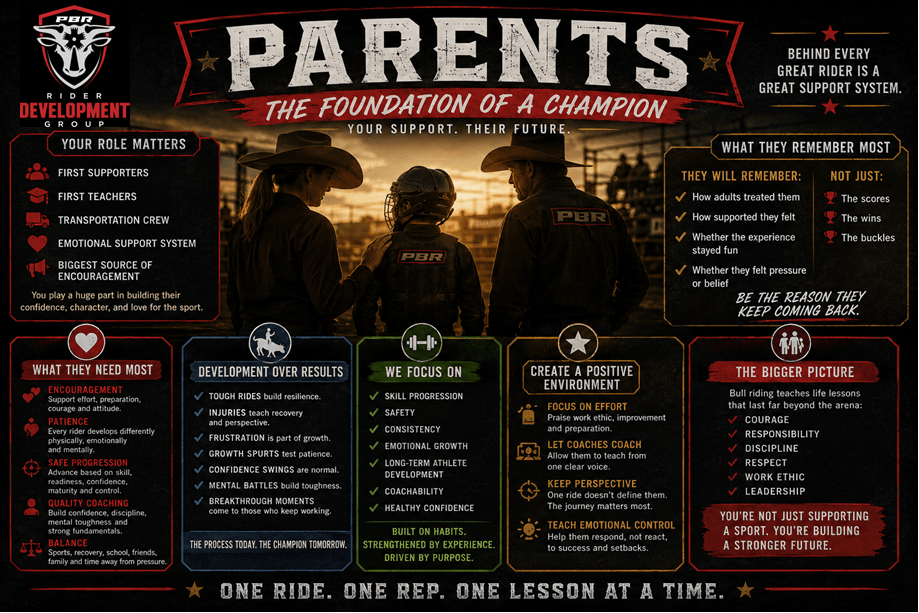
Parents play one of the most influential roles in a young rider’s journey. The way they support, encourage, communicate, and respond during both success and failure has a lasting impact on confidence, motivation, mental toughness, and long-term enjoyment of bull riding.
The Bull Rider Development Model was created to help families better understand how young athletes grow and develop over time. Inspired by modern athlete development systems used across elite sports, the goal is simple:
Create an environment where riders can improve safely, build confidence gradually, and develop into strong competitors and strong people.
Because the best development systems are not built around short-term wins —
they are built around long-term growth.
Parents are often far more than spectators in the stands. They become:
Young riders need to feel supported before they ever feel pressure. Confidence in bull riding often starts at home. Riders who know their parents believe in them are more willing to learn, fail, adjust, and continue growing after difficult rides.
Parents also shape emotional habits long before coaches do. The way adults respond to fear, frustration, adversity, mistakes, and setbacks often becomes the emotional model young athletes carry into competition.
And while many people underestimate it, the long drives, late nights, practice pens, weekend rodeos, and countless hours spent supporting development matters tremendously. Consistency and commitment from parents help create opportunities for growth that young athletes may not fully appreciate until years later.
Bull riding is emotionally demanding. Riders experience fear, disappointment, injuries, pressure, and self-doubt. A calm and supportive parent helps athletes recover emotionally after tough performances and stay motivated through the ups and downs of development.
Encouragement builds resilience. Riders who continue hearing belief and support during difficult moments are far more likely to stay coachable, confident, and committed long term.
Most young riders eventually forget:
Those moments matter, but they fade with time.
What athletes truly remember is:
Young athletes remember whether adults made them feel safe, valued, respected, and supported — especially after mistakes.
Winning feels exciting, but it should never become the only source of confidence or identity for a young rider. Awards and buckles are milestones, not definitions of self-worth.
Fun matters. Athletes who genuinely enjoy the process are more likely to stay engaged, work harder, and continue improving over time.
Pressure creates fear of failure.
Belief creates confidence to grow.
Young riders thrive when they feel trusted more than judged.
The goal is not perfection.
The goal is to help riders love the process of improvement instead of fearing mistakes.
Bull riding development is rarely a straight line.
There will be:
Every rider experiences failure. Tough rides are often where the greatest growth happens if athletes are guided correctly afterward.
Injuries can challenge confidence and identity, especially for young athletes. Riders must learn that recovery is part of development — not a setback that defines them.
Frustration is normal in skill development. Temporary struggle is not proof that an athlete cannot improve.
As young riders grow physically, their balance, timing, coordination, and movement patterns often temporarily change. Patience during these stages is critical.
Confidence in bull riding is rarely constant. The healthiest confidence is built through preparation, habits, repetition, and earned improvement — not results alone.
Mental battles are part of bull riding. Fear, doubt, pressure, and frustration must be trained and managed just like physical skills.
And while development sometimes feels slow, breakthroughs often happen after long periods of unseen growth. Consistent work usually creates progress long before it becomes obvious.
The most successful long-term athletes are not always the riders winning the youngest divisions. Often, the riders who develop gradually, stay healthy, remain coachable, and continue learning become the strongest competitors later in life.
The Bull Rider Development Model focuses on:
Young riders should master fundamentals step-by-step before advancing into higher-risk situations.
Confidence grows fastest when athletes feel physically and emotionally safe while learning.
Consistent habits create reliable performance under pressure.
Learning how to respond to adversity is one of the most valuable lessons bull riding teaches.
Young athletes should develop athleticism, coordination, mobility, body control, and movement efficiency — not simply accumulate rides.
Coachability matters. The ability to listen, adjust, and continue learning is one of the strongest predictors of long-term success.
And true confidence comes from preparation, repetition, and earned growth — not hype or ego.
Success should not only be measured by results.
It should be measured by growth.
Young riders need to know their value is not tied to scores, placings, or wins.
Praise:
Bull riding requires bravery. Recognizing courage helps athletes continue facing fear productively.
Attitude often determines how riders respond to adversity and continue improving.
Every rider develops differently physically, emotionally, and mentally.
Some athletes mature physically earlier.
Some develop emotional control later.
Some naturally handle pressure better at younger ages.
Development is a long-term process.
Avoid comparing your child to other riders. Comparison often creates unnecessary pressure and anxiety that can damage confidence and enjoyment.
Riders should advance based on:
Not pressure, ego, or outside expectations.
Fear-based progression often slows development. Confident athletes learn faster, respond better under pressure, and recover more effectively from setbacks.
Body awareness and movement control also reduce injury risk and improve long-term performance.
The right coach teaches far more than riding mechanics.
Great coaches help riders:
Mental toughness is not ignoring fear —
it is learning how to respond effectively despite it.
The best coaches challenge athletes while still helping them believe they are capable of growth.
Young athletes benefit tremendously from balance.
This includes:
Different sports improve coordination, adaptability, athleticism, and movement quality while helping reduce burnout.
Mental and physical recovery are essential for long-term performance and motivation.
Balanced identity helps riders maintain confidence outside of performance alone.
Burnout often happens when identity becomes tied only to results.
Parents help shape the emotional environment riders develop within.
Healthy development environments prioritize:
Praise:
Work ethic predicts long-term success far more consistently than early talent alone.
Small improvements repeated consistently eventually create major growth.
Prepared athletes feel calmer and more confident under pressure.
Resilience is built every time riders recover from disappointment and continue moving forward.
Allow riders to process instruction from one clear voice.
Too much technical feedback from multiple directions can create confusion, frustration, and anxiety.
The best parent-coach relationships work together to support the athlete instead of competing for control.
Very few rides define a career.
One bad weekend does not erase progress.
One great weekend does not complete development.
The process matters most.
Bull riding teaches valuable life lessons:
The goal is not eliminating pressure —
it is learning how to function effectively within it.
Athletes who learn emotional control become more resilient competitors and healthier people.
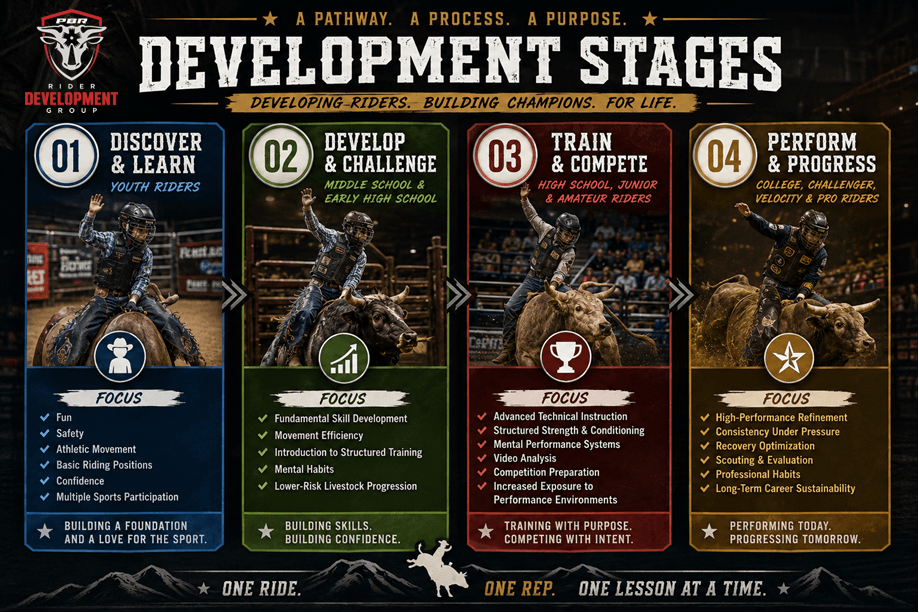
The Bull Rider Development Model follows a progression-based system where riders gradually build:
Different stages require different priorities.
Focus on:
Enjoyment builds long-term commitment.
Safe learning environments improve confidence and skill acquisition.
Strong basics eventually become the foundation for advanced performance later.
Focus on:
Athletes begin improving timing, consistency, movement efficiency, and emotional control.
Practice becomes more intentional and goal oriented.
Competition should challenge riders without overwhelming confidence or safety.
Focus on:
Elite riders rely heavily on routines, preparation, discipline, and emotional control.
Recovery becomes critical for durability and longevity.
Advanced athletes must learn how to manage pressure, expectations, travel, and adversity effectively.
Development is a journey —
not a race.
After rides, consider asking:
Avoid immediately focusing only on:
Riders who feel emotionally supported are more likely to remain confident, resilient, coachable, and motivated long term.
Sometimes the most powerful thing a parent can say after a difficult ride is simply:
“I’m proud of you for getting back out there.”
Bull riding has the power to teach:
The goal of rider development is not only to produce successful competitors.
It is to help young athletes become strong, capable people prepared for challenges both inside and outside the arena.
Years from now, most athletes will not remember every score or buckle.
But they will remember:
The Bull Rider Development Model exists to help families, coaches, and organizations create an environment where riders can thrive for the long term while building a lifelong love for bull riding.
In youth sports, parents are not just logistical support. They are one of the primary influences on whether young athletes stay motivated, confident, emotionally healthy, and committed long term. Research consistently shows that positive parental support, autonomy, encouragement, healthy perspective, and focus on development are linked with better youth sport experiences, while pressure, overemphasis on winning, early specialization, and lack of recovery are linked with burnout, anxiety, injury risk, and dropout.
1. Parents shape motivation, confidence, and enjoyment
Research on youth sport parenting shows that the way parents communicate, encourage, and respond to performance has a major impact on a child’s motivation and sport experience. Supportive parents help athletes feel competent, connected, and motivated; overly pressuring parents can create fear, stress, and dissatisfaction.
Bull riding connection:
A young rider who feels supported after a buck-off is more likely to stay coachable and keep learning. A rider who only feels judged by results may begin riding tight, scared, or outcome-focused.
2. Development should come before winning
The American Academy of Pediatrics emphasizes that youth sports should focus on fun, development, participation, and health — not adult-driven pressure or early performance outcomes. The AAP also notes that the child’s interest should lead participation, not the parent’s ambition.
Bull riding connection:
A buckle at 10 years old should never matter more than whether the rider is building fundamentals, confidence, safety habits, and a love for bull riding.
3. Too much pressure increases burnout risk
The AAP warns that the professionalization of youth sports can contribute to overtraining, burnout, and mental strain. It recommends young athletes have regular rest, including 1–2 days off per week and 2–3 months away from a single sport each year.
Bull riding connection:
Young riders need time away from constant pressure, constant hauling, and constant live riding. Rest, recovery, and other athletic activities are not weakness — they are development.
4. Multi-sport and varied movement matter
The CDC states that children and adolescents should get at least 60 minutes of daily physical activity and that activities should be varied, age-appropriate, and enjoyable. Physical activity supports fitness, bone and muscle strength, cognition, academic performance, and reduced symptoms of depression.
Bull riding connection:
Wrestling, gymnastics, football, soccer, martial arts, strength training, and general play can all help young riders develop balance, coordination, body control, mobility, and confidence.
5. Supportive parents help protect mental health
Youth sport participation is associated with lower anxiety, depression, and stress when the environment is healthy and supportive. The U.S. Department of Health and Human Services notes youth sports can provide immediate and long-term mental, emotional, and social benefits.
Bull riding connection:
Bull riding can build courage, emotional control, discipline, and resilience — but only if the environment helps the rider process fear, failure, injury, and pressure in a healthy way.
6. Autonomy support is critical
Self-determination research shows young athletes thrive when parents and coaches support three needs: autonomy, competence, and relatedness. In simple terms, riders need to feel they have some ownership, they are improving, and they belong.
Bull riding connection:
Parents should help riders take ownership by asking, “What did you learn?” and “What do you want to work on next?” instead of immediately correcting every ride.
After a ride:
· “What did you learn?”
· “What felt better today?”
· “What do you want to improve next?”
· “I’m proud of how you handled that.”
Avoid leading with:
· “Why didn’t you ride him?”
· “You should have won.”
· “You’re better than that kid.”
· “We drove all this way for that?”
The research backs the message: parents should be supporters, stabilizers, encouragers, and perspective-keepers. In bull riding, where fear, risk, failure, and pressure are built into bull riding, the parent’s emotional response can either protect confidence or damage it.
The best parent role is not to create pressure.
It is to build the kind of environment where a young rider wants to keep showing up, keep learning, and keep growing.
Here are some of the strongest and most credible research sources supporting the parent-development concepts discussed above. These are widely referenced across youth athletics, sports psychology, long-term athlete development, and pediatric sports medicine.
Organized Sports for Children, Preadolescents, and Adolescents
This is one of the foundational pediatric sports medicine position papers emphasizing:
AAP – Organized Sports for Children and Adolescents
Professionalization of Youth Sports Can Lead to Burnout
Strong support for:
AAP – Youth Sports Burnout Research
Parental Involvement in Youth Sport: A Systematic Review
Excellent overview of how parents affect:
NIH – Parental Involvement in Youth Sport Review
Youth Sports Strategy Report
Supports:
HHS – National Youth Sports Strategy Report
Physical Activity Guidelines for Children and Adolescents
Supports:
CDC – Youth Physical Activity Guidelines
Strategies Coaches and Parents Can Utilize to Optimize Youth Athlete Experience
This research strongly supports:
Self-Determination Theory & Youth Athletes
Sport for Life / Long-Term Development in Sport and Physical Activity
One of the foundational LTAD frameworks used internationally. Supports:
Sport for Life – Long-Term Athlete Development
Research-backed resources on:
Foundational work supporting:
Mindset Works – Carol Dweck Research
Excellent evidence-based resource for:
The strongest recurring themes across nearly all youth athlete research are:
These principles align extremely well with the Bull Rider Development Model and provide strong scientific support behind the parent philosophy you are building.
Great coaches do far more than teach riding mechanics.
In many ways, coaches become one of the most important influences in a rider’s development journey.
The Bull Rider Development Model was created to help coaches develop athletes through a structured, progressive, and athlete-centered approach designed for long-term success in bull riding. Inspired by modern athlete development systems used across elite sports, the focus is not simply on creating tougher riders — it is about developing healthier, smarter, more complete athletes prepared to perform, grow, and thrive over time.
Because great coaching develops more than riders — it develops people.
A coach’s influence reaches far beyond competition results.
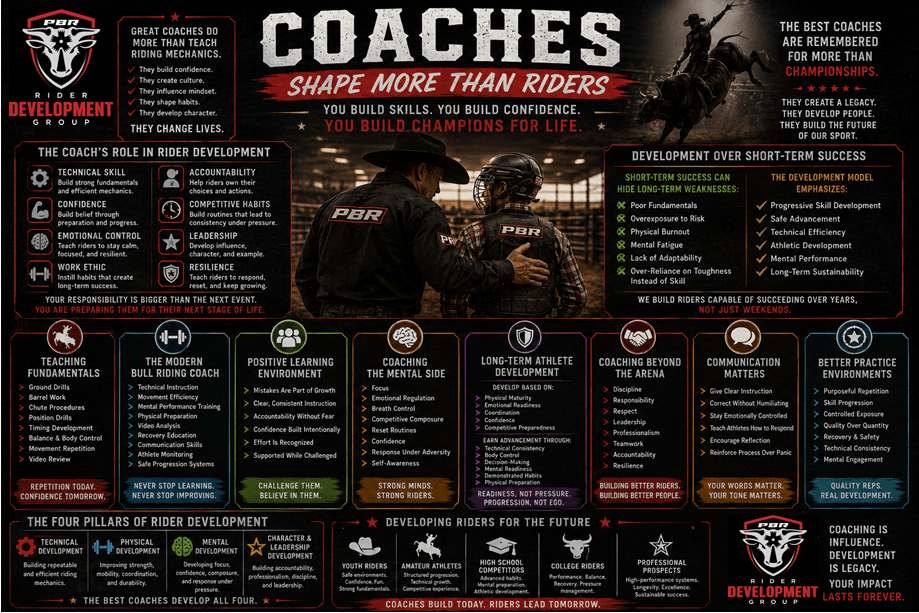
Great coaches help riders develop:
The best coaches understand that development is a long-term process. Their responsibility is not only to prepare riders for the next event, but to prepare them for the next stage of growth.
Technical skills create consistency under pressure. Strong fundamentals allow riders to react faster, recover better, and perform more efficiently during chaotic situations.
Confidence is built through preparation, repetition, and constructive feedback. Confident riders are more decisive, resilient, and aggressive when competition intensifies.
Emotional control is equally important. Bull riding is emotional by nature, and coaches who teach riders how to reset after mistakes help create athletes who can recover quickly and continue competing effectively.
Work ethics often become the separator between talented riders and successful riders. Great coaches teach athletes to value preparation, consistency, discipline, and daily habits.
Leadership and accountability also matter. Riders learn how to own their preparation, decisions, and responses instead of blaming outside circumstances. They learn how to influence teammates, younger athletes, and the culture around them.
And because setbacks are guaranteed in bull riding, resilience becomes essential. Strong coaches teach riders how to reset mentally, recover emotionally, and continue improving after difficult rides, injuries, or adversity.
In youth and developing athletes, the primary goal should always be development — not simply winning early.
Short-term success can sometimes hide long-term weaknesses:
Young athletes who progress too quickly often lose confidence or develop fear after experiences they were not physically or emotionally prepared for.
Mental toughness matters, but toughness without technique often limits long-term success and increases unnecessary risk.
The Bull Rider Development Model emphasizes:
The goal is to build riders capable of succeeding over years — not just weekends.
Today’s successful coaches do far more than simply run practice pens.
Modern rider development includes:
Modern coaching involves teaching precise movement patterns and efficient mechanics — not simply telling athletes to “try harder.”
Movement efficiency allows riders to waste less motion, recover faster, and stay balanced during difficult rides.
Mental performance training helps riders manage fear, pressure, frustration, and adversity productively.
Physical preparation matters as well. Strength, mobility, grip endurance, coordination, and recovery habits all directly impact performance and durability.
Video analysis allows riders to objectively study timing, position, habits, and areas needing improvement.
Recovery education helps athletes stay healthier, reduce injuries, and extend competitive longevity.
And perhaps most importantly, great coaches continue learning, adapting, and improving alongside their athletes.
Strong fundamentals create consistency under pressure.
The Bull Rider Development Model prioritizes repeatable mechanics and efficient movement patterns through:
Ground drills help riders safely develop movement patterns and muscle memory without relying entirely on live bulls.
Barrel work improves balance, timing, body awareness, and recovery mechanics in a controlled environment.
Consistent chute procedures reduce anxiety and help riders improve focus before the gate opens.
Position drills and timing development help riders stay synchronized with the bull instead of reacting late during difficult moments.
Movement repetition creates automatic responses that hold up under pressure, while video review helps athletes better understand corrections and recognize patterns.
Live bulls are important —
but development does not happen only through live riding.
Purposeful repetition and deliberate practice create long-term improvement.
Riders learn best in environments where:
Mistakes provide feedback. Riders who are allowed to learn from errors develop faster and with greater confidence.
Clear communication reduces confusion and helps athletes trust the learning process.
Athletes improve most when they feel challenged — but not emotionally threatened.
Confidence should be built through preparation, progress, and achievable challenges.
Recognizing effort reinforces the habits that create long-term growth.
The best environments push riders while still making them feel safe enough to learn.
Fear-based coaching may create short-term compliance, but it rarely produces long-term confidence, adaptability, or emotional resilience.
Bull riding places athletes under extreme pressure in very short periods of time.
Mental skills training is essential.
Great coaches help riders develop:
Focus training helps riders stay locked into controllable actions instead of distractions or fear.
Breathing techniques help calm the nervous system and improve composure before competition.
Reset routines help athletes mentally recover after mistakes and prepare for the next opportunity.
Self-awareness allows riders to recognize emotional triggers, habits, strengths, and weaknesses.
Athletes who can regulate emotions and stay process-focused perform more consistently under pressure.
The goal is not to remove pressure from bull riding.
The goal is to teach riders how to handle pressure productively.
Every rider develops differently.
Chronological age does not always match:
Some athletes mature physically earlier.
Some develop emotional control later.
Some naturally handle pressure better at younger ages.
The development model encourages coaches to progress riders based on readiness rather than ego, comparison, or outside pressure.
Advancement should be earned through:
Not simply courage alone.
The impact of coaching often extends far beyond bull riding.
Great coaches help teach:
Discipline teaches athletes how to stay committed even when motivation changes.
Responsibility helps riders become dependable both inside and outside competition.
Respect strengthens relationships between athletes, coaches, families, and teammates.
Leadership develops through example, consistency, and accountability.
Even in an individual sport, teamwork and culture matter. Riders learn how to support teammates, younger athletes, and the environment around them.
Many athletes may never become professional riders — but every athlete can benefit from strong mentorship and positive coaching.
The way coaches communicate directly impacts confidence, learning, and emotional development.
Effective coaches:
Simple, direct coaching improves understanding and confidence.
Athletes learn best when corrections build growth rather than embarrassment.
Calm coaches create calmer athletes during stressful situations.
Reflection helps athletes develop self-awareness and long-term learning habits.
Process-focused coaching keeps athletes grounded during pressure-filled moments.
Your words matter.
Your tone matters.
Your response matters.
Effective development systems prioritize:
Every rep should have a purpose connected to improvement.
Athletes should master simple skills before advancing into more difficult challenges.
Controlled progression builds confidence while reducing unnecessary fear and setbacks.
More rides do not always equal more development.
A smaller number of focused, intentional reps often creates more improvement than excessive live riding.
Recovery protects both performance and long-term health.
Athletes improve fastest when they remain mentally connected and intentional during practice.
The quality of the reps matters most.
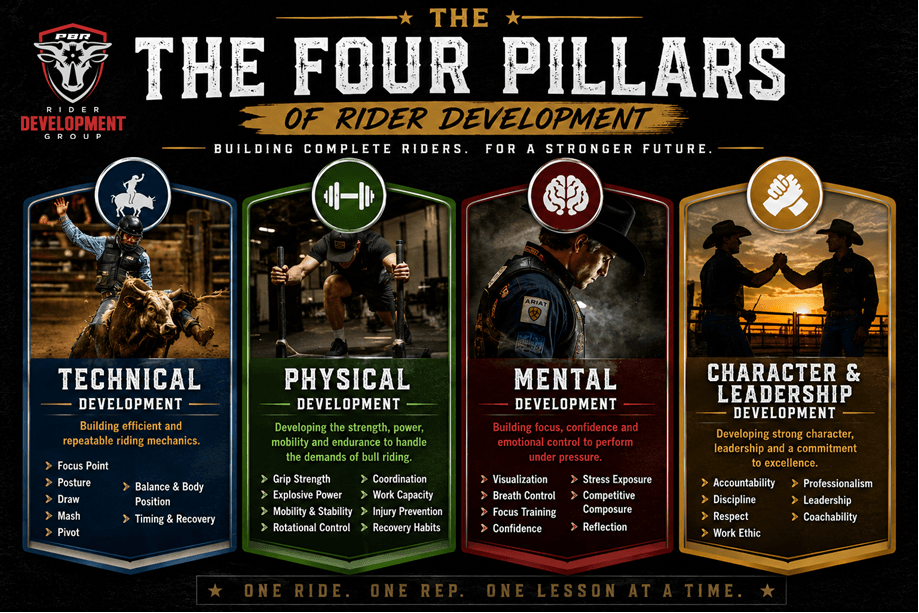
The Bull Rider Development Model is built around four core areas:
Building efficient, repeatable riding mechanics that hold up under pressure.
Improving athleticism, mobility, durability, coordination, and physical readiness.
Teaching riders how to focus, regulate emotions, and respond productively under stress.
Developing discipline, accountability, professionalism, leadership, and resilience that extend far beyond the arena.
The best coaches develop all four.
The future of bull riding depends on building stronger development systems for:
Young riders need safe environments built around confidence, fundamentals, and enjoyment.
As athletes progress, development becomes more structured and intentional. Riders begin building advanced habits, mental routines, physical preparation systems, and professional expectations.
Professional-level athletes require high-performance systems capable of supporting long-term success and sustainability.
Coaches are the center of that future.
By emphasizing:
Coaches help build a healthier, stronger, and more sustainable future for bull riding.
The best coaches are remembered for more than championships.
They are remembered for:
Athletes often perform at levels they first believed possible because a coach believed in them first.
The best lessons extend far beyond riding and remain valuable throughout life.
Strong coaching creates lasting influence that athletes often carry forever.
Because coaching is more than instruction.
It is leadership.
It is mentorship.
It is influence.
And great coaches do not simply develop riders — they help shape the future of bull riding.
HAVE A QUESTION? LOOKING FOR AN OPPORTUNITY? KNOW A RIDER WE SHOULD KNOW ABOUT?
PBR Rider Development is working to build a stronger, clearer pathway for the next generation of bull riders.
Whether you’re a rider looking for your next opportunity, a parent trying to find the right path, a coach looking for resources, or a stock contractor who knows talented young riders, we want to hear from you.
The goal is simple:
Connect the right people. Find developing talent. Create better opportunities. Build the future of bull riding.
Use the Request More Information form below to tell us a little about yourself and how PBR Rider Development can help.
WHEREVER YOU ARE IN YOUR JOURNEY, WE WANT TO KNOW WHO YOU ARE.
You don't have to already be riding at the professional level to get on our radar.
PBR Rider Development is working to identify and support riders at every stage — from developing youth and high school athletes to college riders and young competitors working toward the professional ranks.
If you're looking for information about:
Tell us about yourself.
We can't promise where the road will lead, but we can't know about you if we don't know who you are.
REQUEST MORE INFO / GET IN TOUCH WITH US
HELPING YOU FIND THE RIGHT PATH FOR YOUR RIDER.
There is no single roadmap for raising and developing a young bull rider.
Parents are constantly trying to answer questions:
Where should my rider be competing?
How often should they ride?
How do we find good coaching?
What opportunities are available?
How do we know when they're ready for the next step?
PBR Rider Development is working to make that pathway easier to understand.
If you have a young rider and want to learn more about camps, clinics, development opportunities, resources, or the pathway toward high school, college and eventually professional bull riding, reach out.
Ask the question. Start the conversation.
REQUEST MORE INFO / GET IN TOUCH WITH US
GREAT RIDERS NEED GREAT COACHES.
Coaches are one of the most important parts of the future of bull riding.
PBR Rider Development is working to connect with coaches at the youth, high school, college and professional levels who want to help build better riders and strengthen the sport.
We want to hear from coaches interested in:
Just as important, we want your input.
The people working with riders every day see things we don't. Your experience, ideas and knowledge can help us continue improving how bull riders are developed.
GET IN TOUCH WITH RIDER DEVELOPMENT
YOU SEE TALENT BEFORE MOST PEOPLE DO.
Stock contractors, practice pen operators, bull riding schools and people working in the industry often see young riders long before they appear on a national leaderboard.
You know the kid who keeps showing up.
The rider who works harder than everybody else.
The one with ability who hasn't gotten much exposure yet.
The young athlete who might have something special.
Those are the riders we want to know about.
PBR Rider Development is building a broader network of trusted people across the bull riding community to help identify talented young riders and make sure promising athletes don't fall through the cracks simply because nobody knew their name.
If there's a rider you believe PBR needs to know about, tell us.
You don't need a scouting report.
You don't need to predict how far they'll go.
Just point us in their direction.
We'll take it from there.
TELL US WHO WE SHOULD KNOW ABOUT
HELP US BUILD THE FUTURE OF BULL RIDING
Bull riding has always grown through relationships — riders helping riders, coaches sharing knowledge, stock contractors opening gates, parents driving countless miles, and people in the industry recognizing talent before anyone else does.
PBR Rider Development wants to strengthen that network.
We want to know:
Who is riding?
Who is coaching?
Who is developing talent?
Who needs an opportunity?
And who does PBR need to know about?
If you're part of the bull riding community, we want to hear from you.
Fill out the form. Make the connection. Help us build what comes next.
REQUEST MORE INFO / GET IN TOUCH WITH US
“Standardized training is going to build safer athletes, stronger performance amongst those athletes, and more marketable personalities.”