
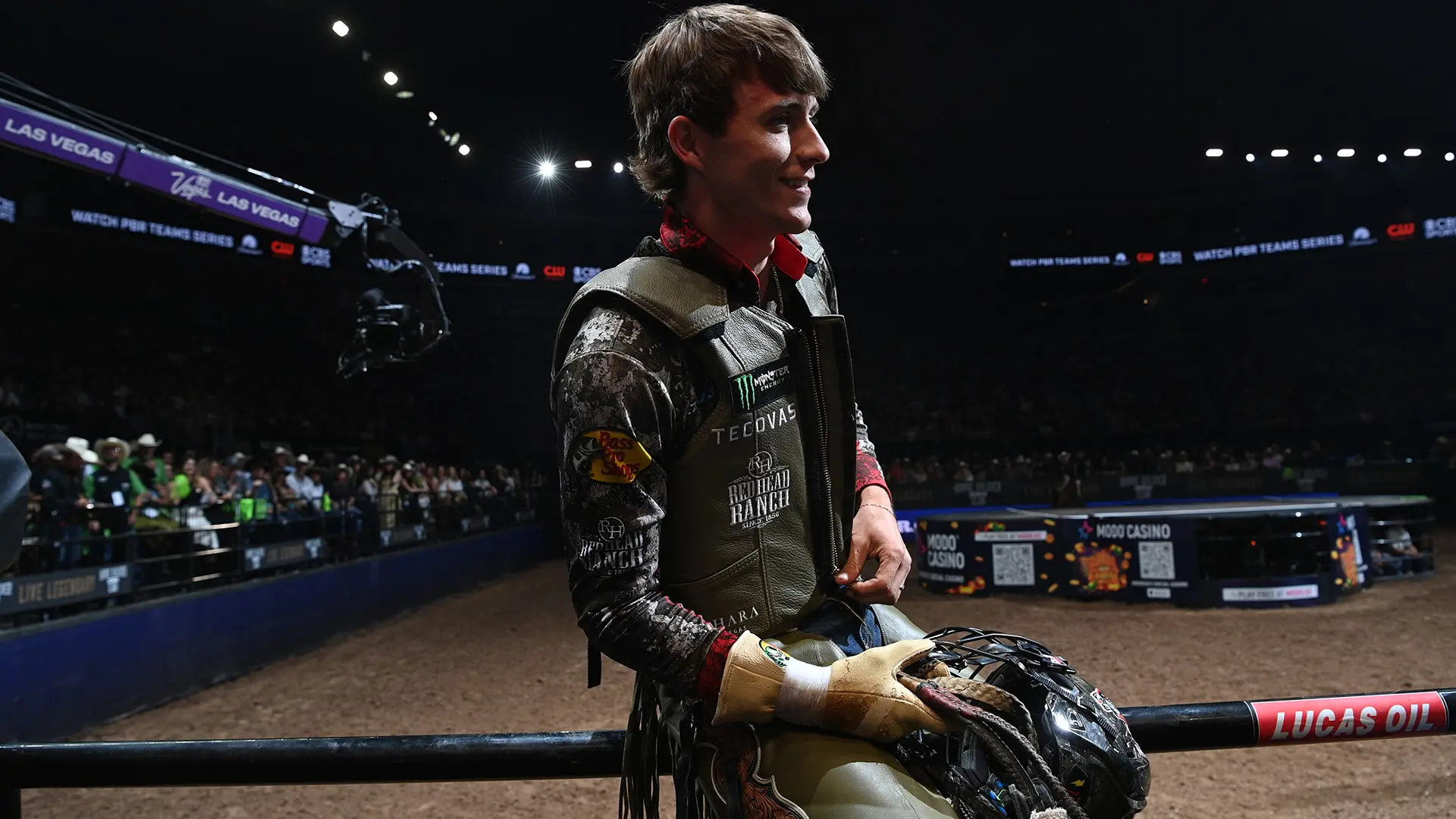
On Aug. 5, Maverick Smith was placed on injured reserve.
His right wrist had been bothering him since Billings during the Unleash The Beast regular season, and after managing the injury through the PBR World Finals and into the beginning of the PBR Teams season, Missouri Thunder finally decided it was time to shut him down.
“We did put Maverick Smith on IR this week,” Thunder head coach Ross Coleman said at the time. “He has a sore wrist, and we're going to try to fix it up here before the next couple weeks and get him a couple weeks off and get him looked at and get his wrist going as strong as we possibly can because you know how good Maverick is.”
Sixteen days later, everybody got another reminder.

Friday night at Gambler Days presented by Tecovas inside Moody Center, Smith climbed into the chutes for Missouri’s final out against the Texas Rattlers with the game still hanging in the balance.
Only his riding hand looked completely different.
Smith reached for his bull rope with his injured right hand and tied in backwards.
Palm down.
Then he rode Dirty Bomb for 89.05 points — becoming the first rider ever to reach the 8-second whistle aboard the bull.
Smith’s 89.05-point ride helped Missouri survive Texas by just 0.70 points, 268.35-267.65.
He had returned from IR and helped seal a win by less than a point.
More importantly, he had proven on bull riding’s biggest stage that the adjustment he had spent the previous two weeks refining away from the bright lights could work when everything counted.
Before Austin, Smith had tested it five times on practice bulls.
There had also been a smaller proving ground at a local rodeo in Kansas, where Smith climbed aboard with his right hand backwards and his wedding ring still on his left.
His wife had been able to go with him as he practiced during his time on IR, and Smith’s face lit up when he talked about having her there through the process.
Those practice pens and smaller rodeos became the laboratory.
Friday night became the test.
And Smith passed it.
The adjustment isn't a trick, preference or attempt to be different.
It is a workaround for an injury involving the distal radioulnar joint, or DRUJ, where the radius and ulna meet near the wrist.
Ligaments between those two bones help stabilize the joint as the forearm rotates. When those ligaments are injured, that stability and rotation can become painful and limited, making it difficult for Smith to turn his palm upward.
For a right-handed bull rider, that matters plenty.
To tie into the rope traditionally, Smith needs to supinate his wrist — essentially rotating his forearm until his palm faces upward.
That movement has become wildly uncomfortable and ineffective since the injury.
So instead of fighting his wrist to reach the position he has used throughout his career, Smith flipped the equation.
He turns his hand over and ties in backwards.
That creates its own set of challenges, though.
Without the same rotation, Smith doesn't engage the biceps the way he normally would. Much more of the work shifts into his forearm, changing not only his grip but the mechanics of his entire riding arm.
If there is anyone built to trade biceps for forearm strength, it is a bull rider.
And there isn't exactly a long list of riders to copy.
Coleman has spent his life around bull riding and can still count the number of men he has personally watched ride that way on one hand.
“I've seen four different guys ever ride that way in person,” Coleman said.
One, Coleman joked, wasn't exactly an advertisement for the technique.
“There’s a guy back in our day that rode. I can't even remember his name, but he was a non-riding sumb*tch,” Coleman said.
But there are far more convincing examples.
Coleman pointed to PRCA bull rider T.J. Gray, who he said suffered the same type of ligament injury as Smith before eventually undergoing surgery.
He also mentioned Trevor Reist, another rider who has successfully competed with his hand reversed.
The technique works.
That doesn't mean it comes without tradeoffs.
“They lose the rope sometimes because it's harder to hold on to the rope,” Coleman said. “It changes your grip for sure. Obviously, if they jack that up, sometimes they lose the rope a little bit.”
That makes Smith's adjustment particularly interesting because of the way Coleman says he already rides.
Smith isn't simply a rider who hangs onto his bull rope and hopes everything else stays underneath him.
His game is built around movement.
“Maverick has a lot of technique and skill of being really leggy and strong,” Coleman said, “and really jumps and takes that power away from the bulls.”
That athletic style may give Smith another tool while he figures out the unfamiliar grip.
Coleman has never started a bull with his hand tied in backwards himself, but he has experienced what it feels like when the rope changes unexpectedly beneath him.
From what Coleman has observed, the type of bull underneath a rider can matter, too.
“If the bull kicks, the bull has a lot of kick, it seems like they get along just fine,” Coleman said.
Which helps explain why Missouri isn't planning to baby Smith through his return.
Friday night, they trusted him with the fifth and potentially decisive out.
Coleman said the backwards grip didn't even factor heavily into how Missouri selected Smith's matchup.
“Even if his hand was regular, he would have the same bull,” Coleman said.
That may say more about the Thunder's confidence in Smith than anything else.
They aren't treating him like a rider who needs protecting.
They are treating him like Maverick Smith.
“Backwards hand, forwards hand, whatever. He's aggressive,” Coleman said. “He's a full throttle bull rider.”
Smith's return does not mean his wrist is suddenly healed.
The distal radioulnar joint remains the issue. Supinating the wrist into his traditional riding position remains difficult. His normal mechanics haven't simply returned because his name came off IR on Aug. 19.
He found another way.
And by Saturday night, even some of the usual signs of an injured wrist were gone.
Smith didn't have the joint wrapped by sports medicine before his matchup. Instead, he simply put some tape around the wrist himself, flipped his hand over once again and climbed aboard Hoka Hey in Missouri's fifth frame against the No. 1 Nashville Stampede.
Eight seconds later, he had done it again.
Smith rode Hoka Hey for 88.10 points, improving to 2-for-2 since returning from IR and 2-for-2 in PBR competition with his riding hand tied in backwards.
When he jumped off, the Missouri Thunder erupted around him, tossing their hats in celebration.
Even Zac Efron, watching from inside Moody Center, looked on and applauded.
Smith, naturally, didn't make much of the moment.
He has never been one to make much noise about any of it. Soft-spoken and rarely overly excited or worked up, he usually offers little more than a small smile and lets his riding do the talking — backwards hand and all.
Bull riders have always been forced to become masters of adaptation because the sport rarely gives them another choice.
Shoulders get taped. Ankles get braced. Hands get wrapped.
By this point in a season, almost nobody feels the way they did when it started.
Smith has simply taken that philosophy somewhere far less conventional.
When his wrist wouldn't turn the way bull riders are taught to turn it, he turned his hand the other way.
When Missouri put him on IR, he didn't spend two weeks simply waiting for permission to return.
He spent them figuring out how.
His wife was there for the practices.
The smaller rodeos provided the first tests.
Coleman watched the progress.
Then, in Austin, Smith turned the experiment into results.
First came 89.05 points on Dirty Bomb — the first qualified ride ever recorded on the bull — with Missouri's game against Texas potentially resting in that backwards right hand.
Then came 88.10 points on Hoka Hey one night later as his teammates threw their hats and celebrated another successful eight seconds.
Going into Sunday, Smith owns a perfect success rate in PBR competition with his hand backwards.
Now comes the third test.
Smith will flip that right hand over again and try to finish Gambler Days a perfect 3-for-3 when he matches up with Easy Come, Easy Go in the first game of the day.
For a wrist that wouldn't turn the right way, Smith has found a pretty effective way around it.
Photo courtesy of Bull Stock Media