Sometimes service looks like climbing into the cockpit of a bomber.
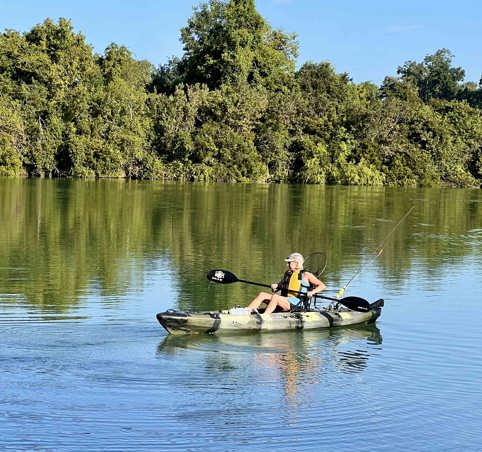
Sometimes it looks like climbing into a kayak.
For Christine Hill, the settings may be completely different, but the purpose has never changed.
Serve the people beside you.
A 1983 graduate of the United States Air Force Academy, Hill spent her military career breaking barriers, flying in support of Desert Storm, serving as chief of tanker air operations and eventually becoming the first woman assigned to fly the B-1B bomber following an assignment to Headquarters Air Combat Command.
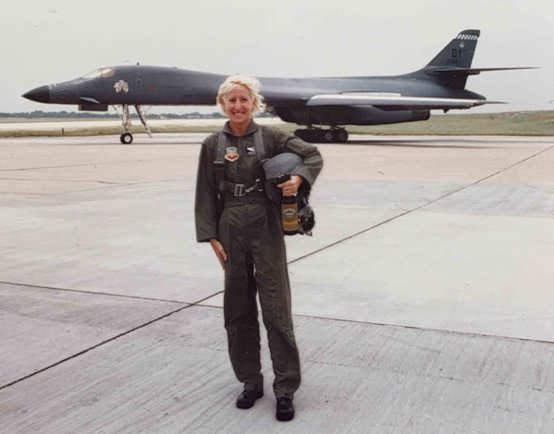
Her career ultimately took her to the Pentagon before she retired from the Air Force.
But retirement never meant the end of service.
Today, Hill continues supporting the men and women who served alongside her through Heroes on the Water, a Texas-based nonprofit providing free, nature-based wellness experiences for veterans, first responders and their families.
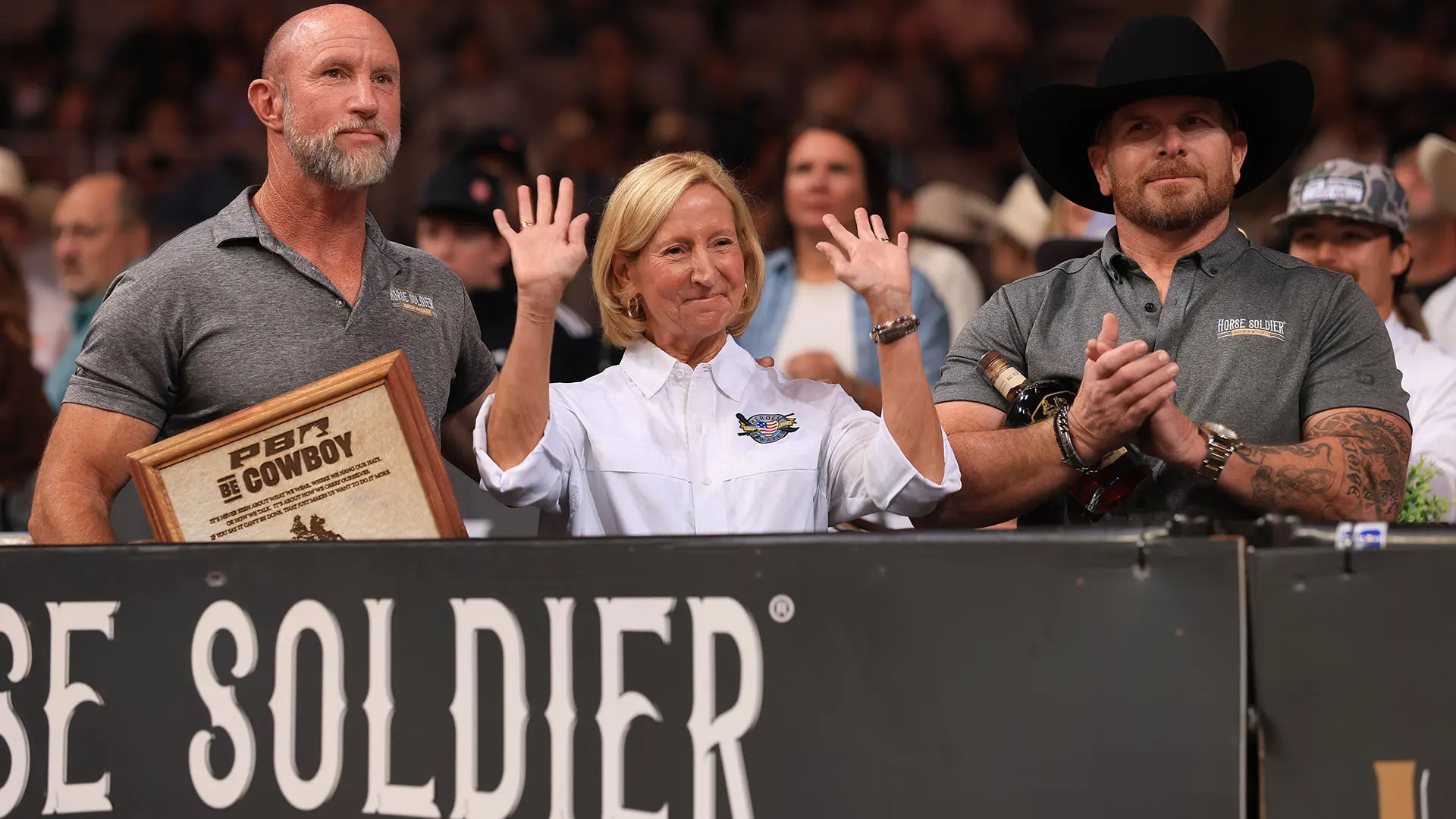
For continuing to serve long after her military career ended, Hill was recognized during PBR Teams’ Rattler Days in Fort Worth with the Horse Soldier Bourbon Be Cowboy Award.
The Be Cowboy Award recognizes everyday heroes who embody the values long associated with the cowboy way of life — courage, integrity, resilience and a willingness to put others before themselves.
You do not have to wear the hat, the buckle or the boots to be a cowboy.
Sometimes, service simply means finding a way to help somebody else feel whole again.
For Hill, that mission began long before she ever stepped onto the water.
Her career in the Air Force placed her in a series of groundbreaking and high-profile roles.
When the uniform came off, however, the instinct to serve remained.
Heroes on the Water eventually invited Hill to join its board, introducing her to an organization using something as simple as a kayak, a fishing rod and a quiet stretch of water to create something much bigger.
Connection and purpose.
And, for many veterans and first responders, a path toward healing.
Heroes on the Water is a 501(c)(3) nonprofit providing alternative wellness programs for veterans, first responders and their families.
Its volunteer-led chapters hold events free of charge, with kayak fishing serving as the organization’s primary vehicle for helping participants step away from the noise of everyday life and reconnect with themselves, their families and a community that understands what they have carried.
For Hill, who has long found being near the water calming and restorative, the mission was a natural fit.
The organization has now served tens of thousands of heroes and family members through thousands of days on the water.
But the impact cannot be measured only by the number of kayaks launched.
It is found in what happens once someone gets there.
Sometimes the constant mental noise begins to quiet.
Stress begins to ease.
A veteran who has spent years operating on alert gets a few hours to focus on nothing more complicated than the next cast.
A first responder finds a community where no explanation is required.
A parent and child sit side by side in a tandem kayak and finally have the conversation they have been struggling to find time for on land.
Sometimes, participants do not even want to get into a kayak.
That is fine too.
They can fish from the bank, sit in a chair, talk with volunteers or simply spend time around people who want them there.
Because healing does not look the same for everyone.
Heroes on the Water has also worked to measure that impact.
Through its Operation Early Impact initiative, developed in partnership with Texas State University using tools created by recreational therapists, the organization found significant improvements among participants.
Ninety-five percent reported reduced stress.
Ninety percent reported improved self-efficacy.
Ninety-one percent reported stronger personal relationships.
The effects can continue long after the kayak is back on the trailer.
For some participants, the experience becomes a regular reset.
For others, it becomes a new community.
Many eventually return as volunteers, buy kayaks of their own, join chapter leadership or begin helping the next person who needs the same opportunity they once did.
That cycle of service is something Hill understands well.
Her military career may have ended, but her responsibility to the people who served never did.
And that made the man presenting her with the Be Cowboy Award especially fitting.
Will Summers, U.S. Army Special Forces, Retired, served 25 years in the Army as a Special Forces communications sergeant and infantry officer.
Following the Sept. 11, 2001, terrorist attacks, Summers was assigned to 5th Special Forces Group’s Operational Detachment Alpha 595, the team that would become known around the world as the “Horse Soldiers.”
Little more than a month after the attacks, Summers and his teammates entered Afghanistan as part of America’s first military response.
Working alongside Northern Alliance forces, the small Special Forces team traveled through the mountainous terrain on horseback and fought Taliban forces as part of a mission that helped topple the regime in a matter of weeks.
The story inspired the book Horse Soldiers, the film 12 Strong and the America’s Response Monument near Ground Zero in New York City.
After retiring from the military, Summers helped carry that legacy into another chapter as one of the veterans behind Horse Soldier Bourbon.
Hill and Summers spent their military careers in different uniforms, performing very different missions.
One took to the skies.
The other rode into Afghanistan on horseback.
But both understand that service does not end when the mission does.
For Hill, it continues every time another veteran, first responder or family member is given an opportunity to get outside, slow down and reconnect.
Heroes on the Water has seen how powerful those moments can become.
There are stories of veterans rediscovering independence after traumatic injuries.
Parents reconnecting with children.
Participants finding enough quiet to finally relax.
And people who arrived needing support eventually returning to offer it to somebody else.
That is where the cowboy code lives.
Not in what someone wears. Not in a title. And not in whether anybody is watching.
It lives in the decision to keep serving when your own chapter could have ended.
Hill spent her Air Force career answering that call for her country.
Today, she answers it for the men and women who served beside her and for the families who carried that service with them.
You do not have to wear the hat, the buckle or the boots to live by the cowboy code.
Sometimes being a cowboy means helping somebody find a little peace after spending a lifetime serving everyone else.
From all of us at PBR and Horse Soldier Bourbon, thank you, Christine Hill, for reminding us what it truly means to Be Cowboy.
Stay tuned after each PBR Teams event of the 2026 season as we continue to spotlight the local heroes and changemakers who inspire us.
Photo courtesy of Bull Stock Media