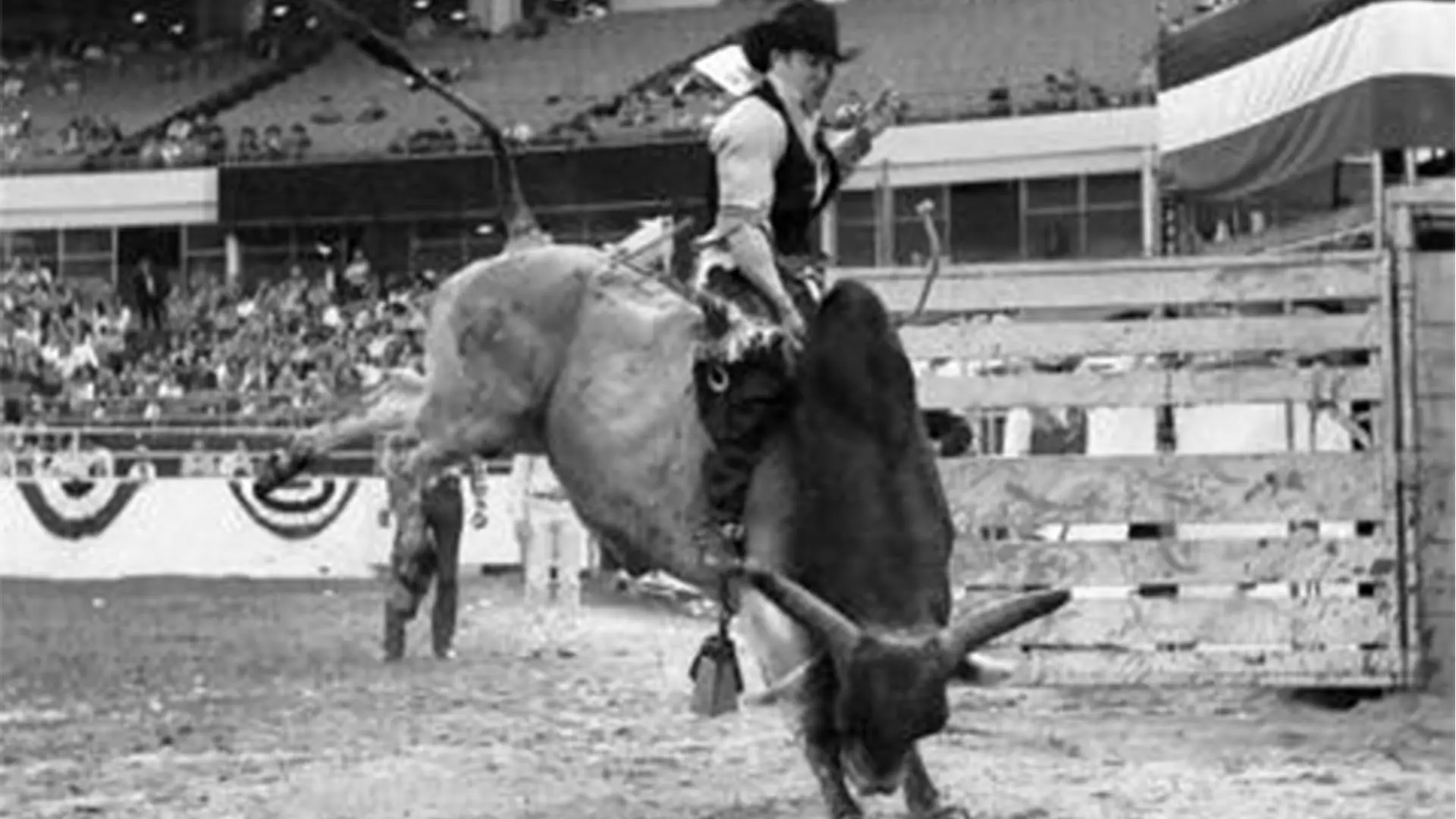
Before George Paul became a World Champion, before he rode 79 consecutive bulls and before his name became permanently tied to one of the most enduring bull riding events in the country, he was a ranch kid near Del Rio, Texas, watching a fictional cowboy on television.
The show was Stoney Burke.
Its title character was a rodeo cowboy traveling from town to town, chasing championships and trying to build a life inside the arena.
Paul was only 14 or 15.
But what he saw stayed with him.

From that point forward, he was determined to become a world champion cowboy.
It was not a passing fascination.
It became the direction of his life.
Paul began competing in junior rodeos, climbing aboard anything that bucked and building the strength, balance and determination that would eventually make him one of the most respected bull riders of his generation.
He would become a champion in multiple events.
He would travel across the United States and Canada in pursuit of rodeos.
He would ride bulls many believed could not be ridden.
And during one remarkable stretch in 1968, he would accomplish something no professional bull rider had done before and no one has duplicated since.
Seventy-nine consecutive qualified rides.
No buckoffs. No missed whistles. Seventy-nine bulls in a row.
Paul’s career lasted only a few short years. But his legacy has endured for more than half a century.
Now, Paul will be inducted posthumously into the PBR Ring of Honor, the highest honor a professional bull rider can receive.
Presented annually to individuals who have made a significant and lasting contribution to bull riding, the Ring of Honor is both a physical ring and a fellowship of men whose blood, sweat, heartaches and handshakes have helped shape the present and future of the sport. The honor reflects PBR’s core values of Only the Best, Authentic, Toughness, Teamwork and Professionalism.
Paul’s natural ability, competitive drive and lasting influence embody each of those principles, making his place among bull riding’s most respected figures a fitting extension of a legacy that has endured for generations.
Born March 5, 1947, Paul was raised in ranching country near Del Rio.
His family was connected to the sprawling San Miguel Ranch in Mexico, an operation reported to encompass approximately 1 million acres.
Paul did not need rodeo to make a living. He did it because he loved it.
From an early age, if an animal bucked, Paul wanted to try to ride it.
That appetite for competition quickly translated into success.
Paul developed through the American Junior Rodeo Association, competing in bull riding, bareback riding and the all-around.
He won the AJRA World Champion Bull Riding title in 1965.
In 1966, he became the AJRA World Champion Bareback Rider.
By 1967, he had added an AJRA All-Around Championship.
Before he entered the professional ranks, Paul had already proven he was more than a bull rider.
He was a complete cowboy.
But bull riding was where his strength, balance and instinct separated him.
Paul was considered by many to be one of the strongest men ever to ride bulls professionally.
That description was not simply about physical power.
It was about the way he could remain centered when a bull exploded beneath him.
It was about his ability to resist the force pulling him away from his hand.
And it was about the confidence he carried into matchups with the rankest bulls professional rodeo could produce.
Paul also sought opportunities to learn.
He attended a rodeo school led by Jim Shoulders, the 16-time World Champion whose own accomplishments had already established him as one of the most influential cowboys in rodeo history.
Paul later described the experience as one of the most beneficial of his career.
In 1966, he joined the Rodeo Cowboys Association, now known as the Professional Rodeo Cowboys Association.
That first season was an education.
Paul learned how to enter professional rodeos, which events made the most sense financially and how to navigate a sport that required competitors to cover enormous distances between performances.
By 1967, the education had turned into results.
Paul began the season with urgency, entering rodeos across multiple states and using his ability as a pilot to reach more events than he could have by car or pickup.
Flying was not a luxury but part of his strategy.
A cowboy could only win money where he competed, and Paul understood that covering more ground created more opportunities.
He owned his own airplane and frequently flew between rodeos, sometimes competing in multiple states within the same day.
His first full season on the professional circuit established him as one of the sport’s brightest young talents.
Paul won money in bull riding at 30 rodeos.
He qualified for the National Finals Rodeo at only 20 years old.
At the 1967 NFR, he rode seven of nine bulls, finished second in the aggregate and ended the season fourth in the world bull riding standings.
His versatility was equally evident.
Paul finished 13th in the World All-Around standings and 17th in bareback riding.
The young cowboy from Del Rio was not simply surviving among the professionals.
He was competing with the best in the world.
Paul’s 1967 victories included bull riding championships at the Snake River Stampede in Nampa, Idaho, and the Days of ’76 Rodeo in Deadwood, South Dakota.
He also tied for the bull riding title at California Rodeo Salinas and won in both bull riding and bareback riding in St. Louis.
By the start of 1968, established rodeo competitors understood that Paul was no temporary sensation.
He was a championship threat.
That season, Paul attacked the rodeo road with extraordinary ambition.
Traveling in his twin-engine Bonanza, he entered approximately 150 rodeos and covered an estimated 125,000 miles across the United States and Canada.
No event was too large. No event was too small.
If he could be entered in both bareback riding and bull riding, he competed in both.
When the schedule only allowed him to enter one, he chose the bulls.
Paul won or placed at a remarkable percentage of the rodeos he entered.
He captured bull riding titles at the Grand National Stock Show and Rodeo in San Francisco, Iowa’s Championship Rodeo in Sidney, the Redding Rodeo and numerous other events.
He also won in Vernon, Texas; St. Paul, Oregon; Sacramento, California; and Omaha, Nebraska.
But somewhere in the middle of the 1968 season, his run became something more than a collection of rodeo victories.
Paul stopped getting bucked off. Bull after bull tried to dislodge him.
None succeeded.
Rank bulls turned back beneath him.
Others leaped, kicked, spun or changed direction.
Paul continued reaching the whistle.
One qualified ride became 10.
Ten became 20.
The streak kept growing.
A professional bull rider is not facing a stationary target or repeating an identical motion.
Every bull presents a different problem.
Some spin tightly into a rider’s hand.
Others turn away from it.
Some leap high into the air.
Some drop their shoulders, kick over their heads or reverse direction without warning.
A single mistimed movement can send a rider into the dirt beneath an animal weighing well over 1,500 pounds.
Paul covered 79 of them consecutively.
The streak was not built against easy competition.
It came against the toughest bulls available in professional rodeo at the time.
It required Paul to remain healthy while traveling constantly, competing repeatedly and riding through the physical punishment that accompanied every out.
By the time Paul arrived at the 1968 National Finals Rodeo in Oklahoma City, he had already secured a commanding lead in the World Championship race.
He did not need to compete at the NFR to preserve his place atop the standings.
Sitting out never seriously occurred to him.
Paul was a competitor.
And he arrived in Oklahoma City carrying a record no one had ever produced.
Seventy-nine consecutive qualified rides.
The streak ended in the opening round.
Cowtown, a powerful bull owned by stock contractor Howard Harris, bucked Paul off in four jumps.
The record stopped at 79.
Paul did not allow the buckoff to define his Finals.
He responded by riding his next eight bulls.
Eight straight qualified rides after being bucked off in the opening round.
Paul finished the NFR eight-for-nine, tying the existing record for the most bulls ridden at the Finals at that time.
The list of bulls he conquered demonstrated the quality of the performance.
There was Jim Shoulders’ Typhoon, who had reportedly gone unridden for three years.
There was Big Bend’s Little Smoke and Kirby’s No. 1, neither of whom had been successfully ridden during the 1968 season.
Kinney Brothers’ No. 25 had been ridden once in 16 attempts.
Steiner’s No. 107 had reportedly been covered once in six years.
Paul rode them all.
His final matchup was Butler Brothers’ No. 27, a bull so difficult to handle that he reportedly had to be pulled into the chute with a tractor and a chain around his horns.
Paul made the whistle.
The ride earned 87 points, the highest score recorded at the 1968 NFR.
When the Finals ended, Paul had won both the NFR aggregate and the RCA Bull Riding World Championship.
He was 21 years old.
The world title confirmed what the rodeo community had already witnessed throughout the season.
George Paul was one of the best bull riders alive.
He had entered the professional ranks only two years earlier.
He had already reached the highest point in the sport.
And there was every reason to believe he would remain there for years.
Paul’s championship season also strengthened his standing as an all-around competitor.
With earnings from both bull riding and bareback riding, he finished fifth in the World All-Around race.
His success was not built solely on one record or one Finals performance.
It was the result of a cowboy who could win across events, rodeos and in every condition.
Yet the 79 consecutive rides became the number permanently connected to his name.
The mark has never been matched.
It stands as one of the most extraordinary records in rodeo history, not only because of its length but because of everything required to sustain it.
Health. Travel. Consistency. Durability. Mental control.
And the ability to solve 79 different bulls before any one of them could solve him.
Paul’s peers understood the rarity of his ability.
Don Gay, who would go on to win eight World Championships in bull riding, later called Paul the greatest natural bull rider of all time.
Paul’s reputation was built not only on the bulls he rode but on the manner in which he rode them.
He was powerful without appearing frantic.
He trusted his ability.
And he climbed into the chute expecting to win.
In 1969, Paul stepped back from the full demands of the rodeo road to spend more time helping with his family’s ranching operation.
The decision did not mean he had abandoned competition.
By 1970, rodeo was calling him back.
Paul again began traveling and winning.
He captured the bull riding championship at the San Antonio Stock Show & Rodeo.
He also returned to California Rodeo Salinas and earned another bull riding title, adding to the championship he had shared there in 1967.
At 23 years old, Paul remained at the beginning of what many expected to become one of the greatest careers in professional rodeo.
He was already a World Champion.
He was already an NFR aggregate winner.
He had already set a record that appeared almost untouchable.
He had only begun to show what the rest of his career might become.
Then, on July 30, 1970, he took his last ride.
Paul was piloting his airplane between rodeos in Colorado and Wyoming when the aircraft crashed near Kemmerer, Wyoming.
The wreckage was found near Commissary Ridge, approximately 300 feet short of the summit.
Paul was killed at 23.
The same airplane that had allowed him to chase rodeos across states and build his championship career became part of its tragic end.
His death cut short a career that had already accomplished more than most cowboys could achieve in decades.
The question of what Paul might have done with more time has remained part of his story.
How many more World Championships could he have won?
How many NFRs could he have reached?
How many records could he have broken?
There are no answers.
Only what he had already proven.
He could win at the highest level.
He could ride bulls others could not.
He could compete across events.
And he possessed a combination of natural talent and determination that his peers believed was nearly unmatched.
Paul’s place in rodeo history did not disappear with his death.
His family ensured it remained alive.
In 1978, his siblings established a bull riding in Del Rio to honor him.
The event became the George Paul Memorial Bull Riding, now known as the George Paul Memorial Xtreme Bull Riding.
Held at the Val Verde County Fairgrounds, it has grown into one of the oldest continuous standalone bull riding events in the country.
The competition was built around more than Paul’s name.
It carried forward the kind of sport he loved.
Bull riders gathering in one arena.
And rank bulls.
Over the years, the George Paul Memorial has drawn some of the most accomplished bull riders in history.
Lane Frost competed there.
So did Charles Sampson, Tuff Hedeman and Jim Sharp.
Each event winner has become part of the memorial’s Wall of Fame, with photographs documenting the champions from the inaugural competition forward.
The arena itself has remained tied to its history.
Several of the original wooden bucking chutes have continued to stand alongside newer structures, retained not because they are the most modern but because they are part of the identity of the event.
The George Paul Memorial also became part of bull riding’s broader popular culture.
In 1993, filmmakers used the Del Rio event while creating 8 Seconds, the movie based on the life and career of Lane Frost.
The production reenacted the 1983 George Paul Memorial, bringing another generation’s attention to both Frost and the event created in Paul’s honor.
New athletes have entered.
New fans have filled the stands.
The sport has evolved.
But Paul’s name has remained.
His accomplishments have also been formally recognized by rodeo’s leading institutions.
Paul was inducted into the ProRodeo Hall of Fame in 1979 as a member of the bull riding category.
In 2007, he was inducted into the National Rodeo Hall of Fame.
Those honors placed him among the champions and pioneers whose careers shaped rodeo history.
The PBR Ring of Honor now extends that recognition into the sport Paul helped foreshadow.
Long before professional bull riding developed into a standalone national league, Paul’s legacy was already being carried through a standalone bull riding bearing his name.
His family’s event demonstrated the appeal of gathering the best bull riders and bulls around a competition dedicated entirely to the sport.
Paul did not live to see the modern PBR.
But the values tied to his career are woven into it.
Respect for the bull.
Commitment to the ride.
An expectation of toughness.
The Ring of Honor was created to recognize athletes whose contributions forever changed bull riding and helped build the sport into what it is today.
Paul belongs in that group not because of what he might have accomplished, but because of what he did.
He won the 1968 World Championship at 21.
He won the NFR aggregate by riding eight of nine bulls.
He competed in bareback riding and finished among the world’s top all-around cowboys.
He traveled relentlessly, entering approximately 150 rodeos during his championship season.
He rode 79 consecutive bulls.
Records are often temporary.
Another athlete eventually runs faster.
Scores more.
Wins more titles.
Paul’s record has remained.
Seventy-nine bulls.
Seventy-nine consecutive qualified rides.
More than a half-century later, no one has equaled it.
But the number alone does not fully explain why George Paul still matters.
He matters because of the ambition that took him from junior rodeos to the top of the professional standings.
Paul’s career was brief.
His impact was not.
The young ranch kid who watched Stoney Burke and decided he would become a World Champion did exactly what he set out to do.
Then he did something even more enduring.
He became part of the foundation of the sport itself.
George Paul’s saddle was emptied far too soon.
His place in bull riding history never will be.