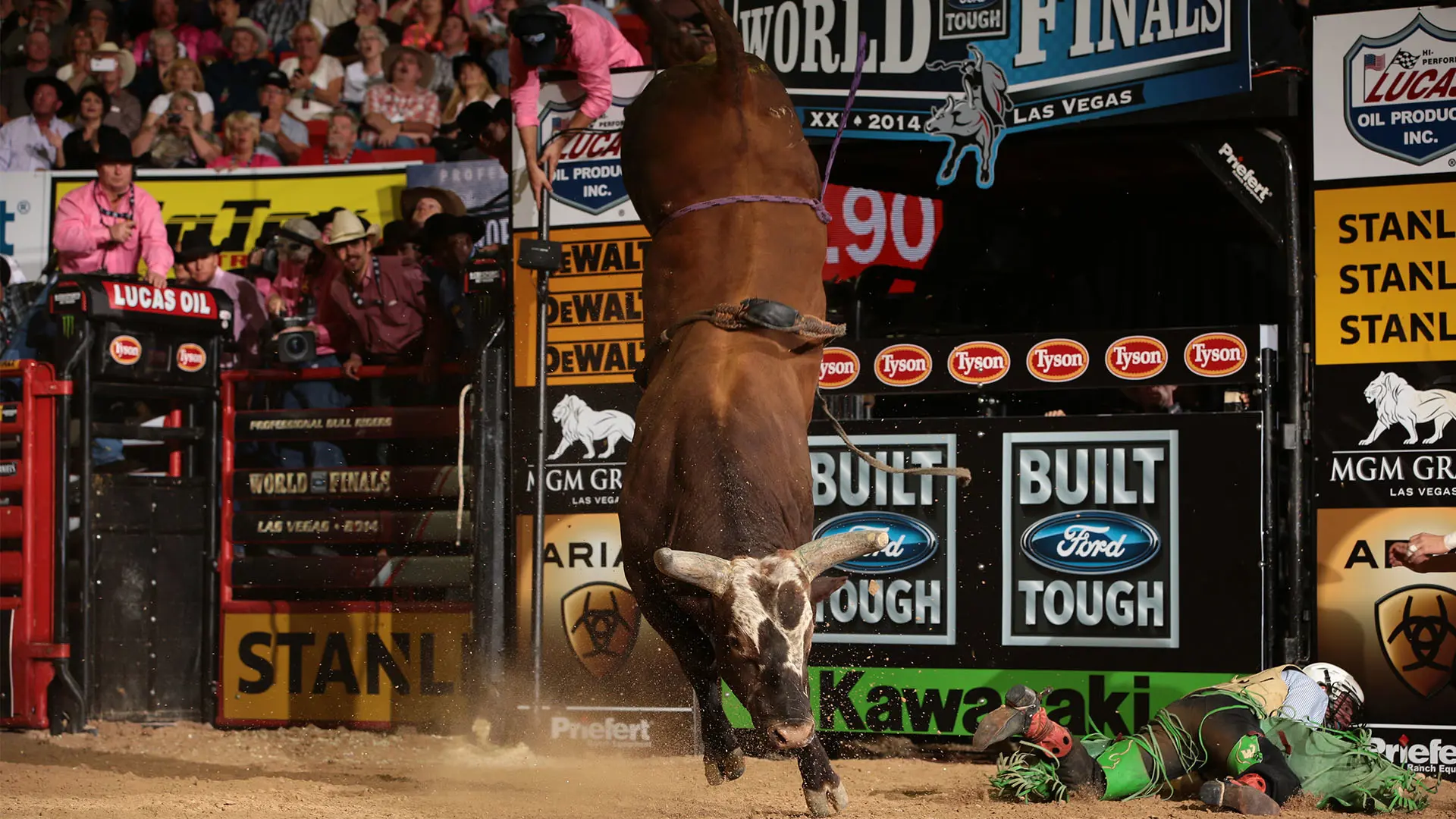
Mirror, mirror on the wall, who’s the rankest of them all?
From Bushwacker and Little Yellow Jacket to SweetPro’s Bruiser, Asteroid, Bodacious and more, some of PBR’s greatest bovine athletes built their legends in very different ways — and decades later, cowboys are still debating which one was the best.
By Harper Lawson
There are some arguments in bull riding that will never be settled.
Put a group of cowboys, stock contractors or longtime fans together long enough and eventually somebody will ask the question:
Who was the greatest bull of all time?
Was it Bushwacker, who became one of the most famous animal athletes the sport has ever seen and once bucked off 42 consecutive riders on the premier series?
Was it Little Yellow Jacket, the rapid-fire spinner who won three consecutive PBR World Champion Bull titles and seemed to know exactly when the cameras were rolling?
Maybe SweetPro’s Bruiser, the most decorated of them all, with championships across PBR, PRCA and ABBI competition.
Or perhaps it was Bodacious, whose sheer power and danger made him a legend never to be matched again.
Ask 10 cowboys and you may get 10 different answers.
And that argument will probably continue for as long as there are bulls on this earth.
The truth is, there may never be one right answer.
They were different bulls, built differently, bucked differently and competed in different eras. Some became famous because almost nobody could ride them. Others became legendary because when a cowboy did make the whistle, both athletes had just created something unforgettable.
A majority of the bulls that belong in this conversation have already received one of the sport’s highest forms of recognition.
Created in 2011, the PBR Brand of Honor is the highest honor a bovine animal athlete can receive, bestowed upon the legendary bulls of the PBR based on consistent championship-caliber performances and career statistical records.
From the beginning, PBR has recognized that there are two great athletes in every ride.
The Brand of Honor is the natural extension of that belief, recognizing animals whose spirit and skill surpassed even the highest expectations of the bull riding world.
Little Yellow Jacket. Dillinger. Chicken on a Chain. Bushwacker. Mossy Oak Mudslinger. Asteroid. SweetPro’s Bruiser. Smooth Operator. Bodacious.
Their names already occupy rare air in the sport.
And yet, even with championships, statistics and the closest thing PBR has to a bovine hall of fame helping make the case, nobody has managed to end the argument.
Maybe that is because greatness looked a little different in each one.
Bushwacker: The superstar
Few bulls ever transcended bull riding quite like Bushwacker.
During his six-year Built Ford Tough Series career, the three-time World Champion Bull became a legitimate sports celebrity. PBR co-founder and longtime Director of Livestock Cody Lambert once compared his impact to legendary racehorses Secretariat and Seabiscuit and placed him alongside some of the most important riders in PBR history.
There were fans who could not name a single cowboy but knew Bushwacker.
In 2013, that celebrity reached well beyond bull riding when Bushwacker became the first animal athlete featured in ESPN The Magazine’s Body Issue, where he was dubbed the “baddest body in sports.”
That level of fame came from dominance.
Bushwacker bucked off 64 of 66 opponents on the premier series and 84 of 87 riders across all levels beginning with his first out in 2009. He won world titles in 2011, 2013 and 2014, becoming the second bull after Little Yellow Jacket to win three PBR World Champion Bull titles. SweetPro’s Bruiser would later join them with championships in 2016, 2017 and 2018.
Then there was the streak.
Forty-two consecutive premier-series buckoffs.
It finally ended in August 2013 when J.B. Mauney, after repeatedly chasing the matchup, rode him for 95.25 points in Tulsa, Oklahoma.
Their rivalry became one of the defining stories in PBR history. They met 13 times across all levels.
Mauney won once.
Stock contractor Julio Moreno remembered one of their earliest meetings in Anaheim in 2011, when Bushwacker erupted beneath Mauney, launching him through the air in 2.67 seconds.
That athleticism separated Bushwacker.
His career average bull score was 46.16 points, among the highest in PBR history, and he bucked off four World Champions: Mauney, Mike Lee, Guilherme Marchi and Silvano Alves.
He was not simply difficult to ride.
He became an attraction unto himself.
Bushwacker eventually received the Brand of Honor in 2016.
By then, the debate was no longer about whether he belonged among the greatest.
It was whether anybody belonged above him.
Little Yellow Jacket: The showman
If Bushwacker was a superstar, Little Yellow Jacket may have been one of bull riding’s greatest performers.
His owners believed he knew when it mattered.
Longtime stock contractor Joe Berger, who raised and co-owned him, remembered the 1,800-pound bull seeking him out after performances almost as if he were waiting to be told he had done a good job.
Tom Teague remembered something similar: Little Yellow Jacket would throw a rider, prance around the arena and carry himself like he knew exactly what he had accomplished.
He certainly had plenty to be proud of.
Little Yellow Jacket won three consecutive PBR World Champion Bull titles in 2002, 2003 and 2004.
During his PBR career from 1999-2005, he posted an 84.4% buckoff rate with an average buckoff time of just 2.66 seconds. The 14 riders who did reach the whistle averaged 93 points.
That tells you almost everything about him.
If he bucked you off, he could do it quickly.
If you rode him, you most definitely won something.
Michael Gaffney matched the PBR record at the time with 96.5 points on Little Yellow Jacket in Nampa, Idaho, in 2004.
Five years earlier, Ty Murray rode him for 90.5 points at the 1999 PBR World Finals and immediately told Lambert the young bull was the real deal.
Then came one of the biggest made-for-television moments in PBR history.
In 2003, Little Yellow Jacket faced two-time World Champion Chris Shivers during a nationally televised matchup with $1 million at stake.
Little Yellow Jacket needed less than two seconds.
That was who he was.
The brighter the lights, the better he seemed to get.
When PBR created the Brand of Honor in 2011, Little Yellow Jacket became its first recipient.
A fitting first name for an honor created specifically for bulls that had exceeded even the sport’s highest expectations.
SweetPro’s Bruiser: The complete champion
When Lambert talked about SweetPro’s Bruiser, he did not need to hedge.
“There’s been so many great bulls throughout our lifetime, but Bruiser is the most decorated bull,” he said.
Three PBR World Championships.
A PRCA World Championship.
An ABBI World Championship.
Everything there was to win, Bruiser seemed to win.
And he did it without relying on danger or some unfair trick.
“He just bucked,” Lambert said.
Bruiser combined difficulty with consistency and athleticism, becoming the type of bull riders wanted because a qualified ride could mean an enormous score.
For PBR legend Jerome Davis, there is no debate at all.
Bruiser is his favorite bull of all time.
And when stock contractor Chad Berger later compared another one of his great bulls, Smooth Operator, to the truly elite animals he had seen, Bruiser belonged in that tiny category alongside Little Yellow Jacket and Bushwacker.
Those bulls, Berger said, were the once-in-a-lifetime kind.
Asteroid: The fighter
If there was ever a bull who proved size did not determine toughness, it was Asteroid.
Two-time World Champion Justin McBride described him in terms usually reserved for cowboys.
Heart.
Asteroid was not the biggest bull competing, but there were days when McBride believed he might have been the strongest.
His 2012 championship season remains one of the most dominant ever produced by a bull.
Asteroid went 17-1 with an average bull score of 46.31 points. His 17 buckoffs on the premier series were the most by a PBR World Champion Bull during his championship season.
Over his premier-series career, he went 67-4.
At one point, 30 consecutive riders failed to make the whistle.
He was marked a career-best 47.5 points four different times.
And he did all of that while competing in the same era as Bushwacker.
Asteroid challenged Bushwacker for world titles in 2011, 2013 and 2014, finishing second twice while still managing to claim the 2012 championship for himself.
McBride compared it to a bull rider trying to become a champion while competing against Jim Sharp in his prime.
That was the level of competition.
And perhaps no moment better captured Asteroid than his showdown with Mauney in San Antonio in 2012.
Mauney rode him for 93.5 points.
McBride called it one of the best rides he had ever seen in PBR and believed the score could have been even higher.
Two great champions met.
Neither gave much away.
That was Asteroid.
His greatness was eventually recognized with the Brand of Honor.
Smooth Operator: The once-in-a-lifetime bull
The first time Chad Berger saw Smooth Operator, the bull was only 4 years old.
Berger watched him at the PBR World Finals during the Classic and immediately saw something different.
Smooth Operator eventually became a two-time YETI World Champion Bull and earned the 2024 PBR Brand of Honor.
But what stands out about Berger’s description of him is not one score or one championship.
It is the category in which Berger placed him.
Little Yellow Jacket.
Bushwacker.
SweetPro’s Bruiser.
Smooth Operator.
The bulls a stock contractor may be fortunate enough to find once in a lifetime.
Berger believed the elite ones shared something almost impossible to quantify.
Their heart was bigger than their body.
That may be one of the best descriptions of greatness in bucking bulls.
Mossy Oak Mudslinger: The cowboy’s draw
Not every legendary bull earned his reputation by being nearly impossible to ride.
Mossy Oak Mudslinger became special for another reason.
Cowboys wanted him.
He bucked hard. He was difficult. But he was honest, consistent and gave riders an opportunity to win.
“He bucked every time,” Lee said. “He wasn’t nasty.”
Lee knew better than most.
At the 2004 PBR World Finals, with a world championship on the line, Lee climbed aboard Mudslinger and rode him for a career-high 93.75 points.
That ride helped Lee become the first cowboy in PBR history to win the World Championship and World Finals event title in the same season.
One ride...Roughly $1.3 million.
And the kind of bull beneath him that could change a career.
Mudslinger finished 66-27 in 93 Built Ford Tough Series outs with an average bull score of 45.88 points. Fifteen times, a cowboy rode him to a BFTS round victory.
In 2005, every rider who successfully covered him scored 90 points or better.
That is a remarkable legacy of its own.
Mudslinger could beat you.
But if you were good enough to beat him, he might help make your season.
He went out a champion, too.
After five years without a world title, Mudslinger was voted the 2006 PBR World Champion Bull. His final matchup came against Marchi at that year’s World Finals.
The result was a 5.1-second buckoff and a 46.5-point bull score.
One last great out.
In 2017, Mudslinger became the seventh bovine athlete to receive the Brand of Honor.
For H.D. Page, the honor meant more than statistics.
Mudslinger arrived at a time when Page could no longer ride bulls and was trying to figure out what came next. Watching the young bull buck gave him the same goosebumps he used to feel climbing onto one himself.
Mudslinger did not simply become a champion.
He helped point a stock contractor toward what came next.
Chicken on a Chain: The giant who could move
At more than 2,100 pounds, Chicken on a Chain did not exactly blend into the background.
His horns were compared to baseball bats.
His attitude could intimidate.
His size alone made him imposing.
Then he moved.
That was the part that made him extraordinary.
For a bull that big, Chicken on a Chain possessed remarkable athleticism. Former riders described him as a freak of nature, an enormous bull capable of moving with a speed that did not seem possible for his size.
And he did it for years.
Chicken on a Chain finished his career with 130 outs, including 80 at Built Ford Tough Series events. He averaged 45 points per out and became the only bull in PBR history at the time with more than 100 outs and a career average of at least 45 points.
He was high-marked 41 times in his 80 premier-series appearances.
Of the 27 times he was ridden, the cowboy won the round 13 times.
His most famous matchup may have come against Renato Nunes in St. Louis in 2008.
Nunes rode him for 95.75 points.
It was exactly the kind of matchup that made Chicken on a Chain special: an elite bull and an elite cowboy combining for something greater than either could create alone.
His durability made him just as remarkable.
Chicken traveled from North Carolina across the country, from Florida to Maine and west to California, Oregon, Idaho, Montana and Las Vegas.
Mauney marveled that there were not many bulls capable of traveling that many miles for that many years and remaining that good.
The 2007 World Champion Bull received the Brand of Honor in 2015.
Even years after his retirement, fans still wanted to see him.
That may say as much about his place in PBR history as any statistic.
Dillinger: Power with speed
Before Bushwacker.
Before Bruiser.
There was Dillinger.
The 1,800-pound black bull with the white face became the first back-to-back PBR World Champion Bull, winning in 2000 and 2001.
Lambert remembered him as a larger animal who still possessed the same speed and agility as smaller elite bulls, only with more power attached.
His numbers support the memory.
Dillinger posted an 85.11% buckoff rate in Built Ford Tough Series competition and was ridden only seven times in 47 outs. His average bull score was 46.83.
But perhaps the best way to understand Dillinger is to look at what happened when somebody did ride him.
Shivers rode him for 96.5 points at the 2001 PBR World Finals, then the highest score in World Finals history and tied for the highest in PBR history.
Sharp was 95.5 on him.
Ednei Caminhas was 95.
Corey Navarre was 94.5.
Dillinger was part of five of the 50 highest scores in PBR history at the time and three of the top 10 World Finals scores.
Like Mudslinger and Little Yellow Jacket, he could produce greatness on both sides of the matchup.
Dillinger became the second bull to receive the Brand of Honor in 2012.
Bodacious: The dangerous legend
Some bulls are remembered for their scores.
Some for championships.
Bodacious is remembered partly for the feeling he created before the gate ever opened.
The 1,900-pound yellow bull was considered by many one of the greatest ever to buck — and perhaps the most dangerous.
He won the 1995 PBR Champion Bull title along with PRCA titles in 1994 and 1995, making him and SweetPro’s Bruiser the only bulls in this group to win championships in both organizations.
But Bodacious also seriously injured multiple riders.
His owner, Sammy Andrews, eventually retired him in 1995.
That danger became inseparable from his legend.
He represented an era when sheer size, explosiveness and intimidation could make a bull famous far beyond the statistics attached to his name.
And decades later, his place among the legendary bovine athletes of the sport was formalized with the PBR Brand of Honor.
Pearl Harbor: Explosive by nature
Then there was Pearl Harbor.
A black-and-white bull remembered for explosive energy and tremendous agility, Pearl Harbor brought a style that forced riders to react immediately.
He built his reputation on the kind of athleticism that could make an elite bovine look almost effortless while the cowboy above him fought for every fraction of a second.
His career included a run of 28 consecutive buckoffs before retirement in 2018.
Pearl Harbor belongs in the conversation for the same reason so many of these bulls do.
He had his own way of doing the job.
The greatest bulls are not carbon copies of one another.
Some were enormous.
Some were smaller and brutally quick.
Some spun.
Some jumped.
Some had immense power.
Some seemed to have an internal understanding of when the moment was biggest.
Pearl Harbor added his own style to that lineage of rank bovine athletes.
More than an eight-second athlete
The debate over which bull was the best can sometimes obscure something even more important.
These bulls did not appear by accident.
Modern bucking bulls are the product of generations of purpose-bred genetics, with bloodlines developed around athletic ability, bucking instinct, power and consistency.
They are born athletes.
And the best of them appear to genuinely understand and enjoy their job.
The great bulls have also passed those genetics forward.
Chicken on a Chain remained part of the industry through breeding after retirement. Bushwacker’s son Clifford eventually reached the premier series himself.
The influence of a great bull therefore does not necessarily end when he walks out of the arena for the final time.
His bloodline can keep bucking.
A great bull can shape what the next generation looks like.
That is part of why the sport talks about these animals differently than ordinary livestock.
They are bred to perform.
They are cared for as elite animal athletes.
And when the gate opens, they do what generations of genetics have prepared them to do.
Buck.
So who was the greatest?
This is where the argument starts all over again.
Bushwacker?
Little Yellow Jacket?
Bruiser?
Asteroid?
Dillinger?
Mudslinger?
Chicken on a Chain?
Smooth Operator?
Pearl Harbor?
Bodacious?
There are championship trophies and buckoff percentages available to make a case.
There are bull scores.
There are record-setting rides.
There are Brand of Honor plaques.
There are generations of cowboys with firsthand memories of what it felt like to nod their head while sitting on one of them.
And none of it has settled anything.
Jerome Davis can tell you Bruiser is his favorite bull of all time.
Someone who watched Little Yellow Jacket dominate three consecutive seasons may never move him from No. 1.
Another fan watched Bushwacker turn Mauney into his defining rival and believes the discussion ends there.
Someone else can point toward Asteroid going toe-to-toe with Bushwacker, Mudslinger giving cowboys a chance to win championships, Chicken on a Chain hauling thousands upon thousands of miles without losing his greatness, Dillinger producing some of the highest scores the sport had ever seen or Bodacious simply being Bodacious.
And they can argue until the lights go out, like they did on Mauney.
Then they can start again the next morning.
That argument is as old as great bucking bulls themselves, and as long as bulls continue to walk this earth, it probably is not going anywhere.
Maybe it should not.
Because the answer depends on what somebody believes greatness looks like.
Dominance?
Longevity?
Championships?
Difficulty?
Athleticism?
Personality?
The ability to make another athlete great?
Every bull on this list could make a case in a different category.
That is why the Brand of Honor matters.
It does not ask everyone to agree on which one was No. 1.
But they all deserve to share one category: championship-caliber animal athletes whose spirit, skill, consistency and career records helped define PBR itself.
From the beginning, PBR has understood something fundamental about this sport.
There are two athletes in every ride.
One climbs into the chute.
The other is already waiting there.
And when the greatest cowboys in the world nod their heads on the greatest bulls in the world, nobody knows exactly what will happen next.
That is the attraction.
And that is why, decades later, cowboys are still debating which bull was the rankest of them all.