Sometimes being a cowboy means riding into danger.
Sometimes it means running toward someone who needs help.
For Captain Max Sarver and Senior Airman Wyatt Lupien, it meant putting down their golf clubs and using their military medical training when a stranger's life hung in the balance.
On July 19, the two Airmen, both assigned to the 56th Operational Medical Readiness Squadron at Luke Air Force Base in Arizona, were enjoying a Sunday morning at Falcon Dunes Golf Course when they noticed something was wrong.
A nearby group of golfers was urgently waving for help.
What had started as an ordinary round of golf suddenly became a race against time.
When Sarver and Lupien reached the group, they found an unconscious veteran lying on the ground, surrounded by bystanders desperately trying to help.
The man was experiencing sudden cardiac arrest.
There was no time to hesitate.
"It looked like something wasn't right," Lupien told Airman 1st Class Rebecca Wagner of the 56th Fighter Wing Public Affairs. "I saw someone attempting CPR. I checked for a pulse, checked for breathing and immediately started compressions."
Recognizing that the CPR being administered wasn't effective, Lupien took over chest compressions while Sarver secured the veteran's airway and monitored his condition.
Several minutes later, golf course personnel arrived with an automated external defibrillator (AED).
Lupien quickly applied the pads while Sarver exposed the man's chest. The device detected a shockable heart rhythm and delivered a shock before directing them to continue CPR.
But emergency responders had not yet arrived.
For approximately eight minutes, the two Airmen continued providing lifesaving care.
Eight minutes.
In professional bull riding, that's enough time for 60 eight-second rides.
On that golf course, it was eight minutes of chest compressions, monitoring and fighting to keep a stranger alive.
And every second mattered.
Emergency responders eventually arrived and transported the veteran to a local intensive care unit. Sarver and Lupien later learned he had survived the initial medical emergency, with their immediate intervention significantly improving his chances of recovery.
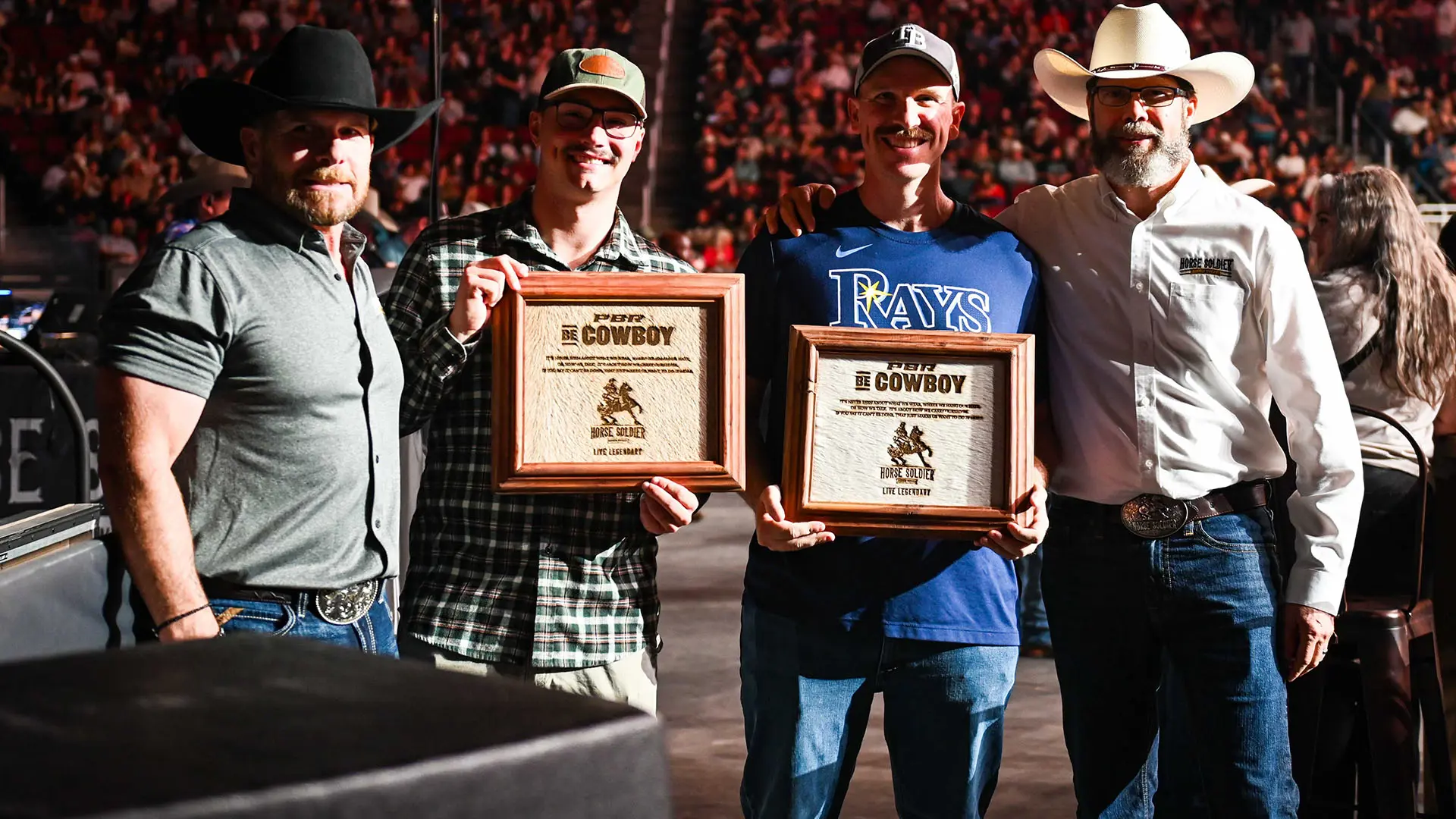
For their courage, decisive action and willingness to help someone in need, Sarver and Lupien were recognized during PBR Teams' Ridge Rider Days presented by Energy Transfer in Glendale, Arizona, with the Horse Soldier Bourbon Be Cowboy Award.
The Be Cowboy Award recognizes everyday heroes who embody the values long associated with the cowboy way of life — courage, integrity, resilience and a willingness to put others before themselves.
You don't have to wear the hat, the buckle or the boots to be a cowboy.
Sometimes, all it takes is recognizing that someone needs help and refusing to stand by.
For Lupien, the decision to act came down to trusting the training he had received.
"You kind of empty your mind and go back to what you've practiced," Lupien said in Wagner's reporting. "I had just taken basic life support (training) earlier this year."
Both Airmen credited their CPR readiness training and Tactical Combat Casualty Care training for preparing them to respond calmly under pressure.
Although their everyday responsibilities center on optometry and ensuring Airmen have the vision capabilities necessary to complete their missions, their military training extends far beyond the clinic.
And on July 19, that preparation proved invaluable.
"(Lupien) jumped right on it with no hesitation whatsoever," Sarver told Wagner. "He was doing exactly what his training prepared him to do."
Lupien entered the Air Force in September 2023, bringing with him experience working as a mental health technician and security guard at Osawatomie State Hospital in Kansas.
Today, he serves as an optometry technician with the 56th Medical Group at Luke Air Force Base, where he helps manage patient care and clinical operations.
His responsibilities include overseeing the procurement and repair of military spectacles and managing clinic programs involving safety and infection control, all in support of the fighter pilots, student pilots and personnel who depend on mission-ready vision.
In 2026, Lupien also participated in the Green River Innovative Readiness Training mission in Henderson, Kentucky, helping deliver healthcare services to underserved communities.
His lifesaving actions on the golf course later earned him the Air Force Commendation Medal for heroism.
But when reflecting on the emergency, Lupien didn't point to his awards or military experience.
He pointed to preparation.
"Commit to your training," Lupien said in the 56th Fighter Wing Public Affairs report. "That's the only reason I felt as comfortable as I did taking charge of the scene."
For Sarver, a Doctor of Optometry and the Optometry Element Chief at Luke Air Force Base, the moment was another example of the responsibility that comes with wearing the uniform.
His path to the Air Force began more than a decade earlier.
After graduating from the University of South Florida in 2012 with a degree in biology on an Army ROTC scholarship, Sarver was commissioned as a U.S. Army officer in 2013.
He later earned his Doctor of Optometry degree from the Inter-American University of Puerto Rico in 2017.
Over more than 12 years in the Army Reserve, Sarver held several leadership positions, including serving as company commander of the 315th Optometry Detachment at Fort Dix, New Jersey.
His military service earned him a Meritorious Service Medal, Army Commendation Medal, two Army Achievement Medals and three Army Reserve Components Achievement Medals.
In July 2025, he transitioned to active duty in the U.S. Air Force, bringing his years of leadership and medical experience to Luke Air Force Base.
Today, he oversees optometry clinic operations and supports the vision and operational readiness of the Airmen stationed there.
In June 2026, Sarver was selected for promotion to major. He received the Air Force Commendation Medal in July and was recognized as the Group Company Grade Officer of the Quarter for the third quarter of 2026.
But the recognition he received in Glendale celebrated a different kind of service.
One that happened far from a military installation, without orders, a mission briefing or any expectation of recognition.
It happened because two people saw someone in trouble and knew they could help.
"If we weren't there, I don't think that man would have survived," Sarver told Wagner. "We were at the right place at the right time."
That sense of responsibility extends beyond Sarver's military career.
At home in Surprise, Arizona, he is a husband and father to four-year-old twin daughters and a one-year-old son. Outside the clinic, he spends his time with family, coaching his daughters' T-ball team and cheering on his favorite Tampa Bay sports teams.
For Sarver, the Be Cowboy spirit is about leading by example, caring for others and having the integrity to do what is right, even when doing so is difficult.
It's a philosophy he strives to carry into every part of his life, whether he's wearing his uniform, leading his medical team or raising his children.
Lupien, who lives in Litchfield Park with his wife and their two cats, enjoys hiking, fishing, hunting and staying connected with childhood friends back home in Kansas.
Different backgrounds. Different military journeys.
But on that Sunday morning, they shared the same instinct.
Help first. Ask questions later.
And that makes the history behind the award they received especially fitting.
Presenting the two Airmen with the Be Cowboy Award was Vince Makela, a retired U.S. Army Sergeant Major, Green Beret and one of the original "Horse Soldiers" who rode into northern Afghanistan following the Sept. 11, 2001, terrorist attacks.
Makela served with the 5th Special Forces Group's Operational Detachment Alpha 595, one of the first Special Forces teams deployed to Afghanistan in the weeks following 9/11.
In October 2001, Makela and his fellow Green Berets were flown by Chinook helicopter into the rugged Hindu Kush mountains, where they joined forces with the Northern Alliance to confront Taliban and Al-Qaeda forces.
But their mission would look unlike almost anything in modern American warfare.
Rather than armored vehicles or military convoys, the soldiers found themselves navigating treacherous mountain terrain on horseback, riding animals provided by Afghan allies as they helped coordinate the campaign against Taliban positions.
The mission became one of the defining stories of America's initial response to 9/11.
Within weeks, the allied forces helped capture the strategic city of Mazar-i-Sharif, delivering an early victory in the war in Afghanistan.
The Green Berets became known as the Horse Soldiers, their extraordinary mission later inspiring the book Horse Soldiers, the 2018 film 12 Strong and America's Response Monument near Ground Zero in New York City.
For Makela, who retired from the Army in 2023, the Horse Soldier legacy extends far beyond what happened on the battlefield.
It represents the courage to answer the call, the resilience to overcome seemingly impossible circumstances and the responsibility to serve others, even when doing so comes at great personal risk.
Today, that legacy lives on through Horse Soldier Bourbon, a veteran-founded brand that honors the history of those missions while continuing to recognize individuals who embody those same values.
And in Glendale, Makela helped carry that legacy forward by recognizing two fellow service members whose own moment of courage happened thousands of miles from a battlefield.
Makela and the two Airmen being honored at Ridge Rider Days served in different circumstances and faced very different challenges.
One rode into a war zone on horseback.
The other two were simply trying to enjoy a round of golf.
But all three understood something fundamental about service.
You don't always get to choose when someone needs you.
You only get to choose how you respond.
For Sarver and Lupien, there was no audience cheering them on when they rushed to the veteran's side. No expectation of applause. No guarantee that their efforts would be enough.
Just a stranger who needed help, the training to provide it and the willingness to act.
Eight minutes later, they had given a fellow veteran a fighting chance at life.
That is where the cowboy code lives.
Not in what someone wears. Not in a title. And certainly not in whether anyone is watching.
It lives in the courage to step forward when others need you most.
Sarver and Lupien didn't arrive at Falcon Dunes Golf Course expecting to become heroes.
They arrived expecting a quiet Sunday morning.
But when the moment came, they answered the call.
And sometimes, that's all it takes to Be Cowboy.
From all of us at PBR and Horse Soldier Bourbon, thank you, Captain Max Sarver and Senior Airman Wyatt Lupien, for reminding us what it truly means to Be Cowboy.
Stay tuned after each PBR Teams event of the 2026 season as we continue to spotlight the local heroes and changemakers who inspire us.
U.S. Air Force photo courtesy of Senior Airman Albert Morel