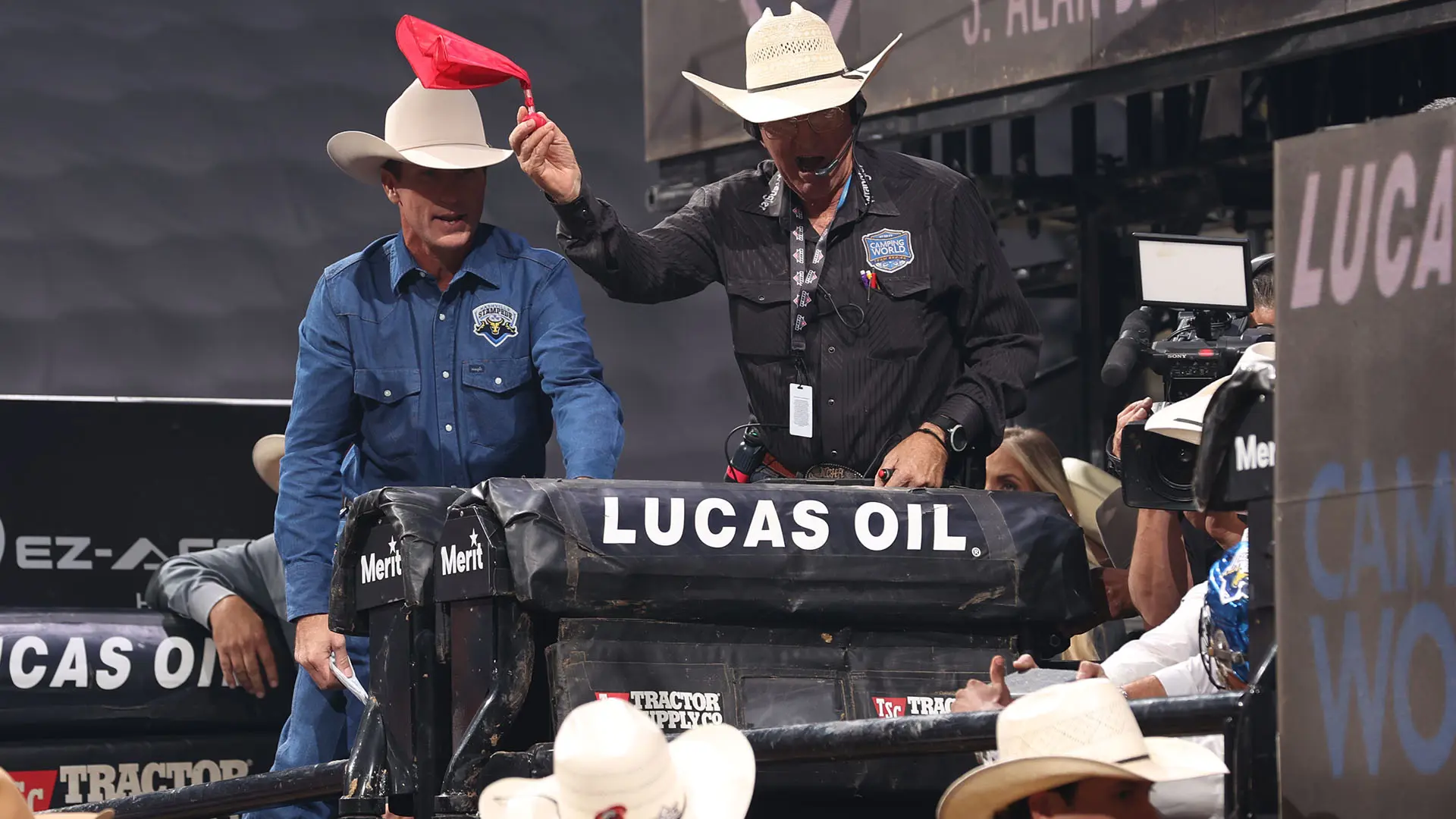
There is an Oz behind the curtain at a PBR Teams event.
Literally.
When a challenge flag flies and the arena turns its attention toward replay, Clint Adkins has occasionally referred to J.J. Quintana as “the judge in the undisclosed location.”
That sounds appropriately mysterious. Secret room. Hidden monitors. Maybe a bank of flashing red lights and a giant lever labeled OVERTURN.
The reality is considerably different.
Quintana is sitting within seeing distance of the back of the chutes, tucked into the loading dock behind an actual curtain. Inside is a narrow cubicle with carpeted walls, soundproofing on the ceiling and just enough room for Quintana, Shawn Terrell and the technology required to determine whether a cowboy’s hand brushed a bull for a fraction of a second.
So yes, there is a man behind the curtain.
Only this Oz has roughly 10 camera angles, a headset and no shortage of people waiting to disagree with him.

Beside Quintana sits Terrell, the other man behind the curtain and keeper of what is affectionately called the “Dream Catcher,” a small box that clips and saves the replay feeds so teams can go back and review a challenge afterward, or PBR can use the footage later to break down a ruling for Rules 101.
During a challenge, though, dreaming is not really part of the job description.
In front of them are 10 camera feeds, a clock screen and what looks like approximately 7,785,900 glowing buttons. It has a slight 1980s-disco feel to it, but Quintana and Terrell have the whole thing down to a remarkably streamlined system.
The replay booth judge position used to rotate. Now, Quintana is the constant.
And a surprising amount of his night involves clocks.
There is Sky Start, an AI-based camera system that marks points on the bull and triggers the start of the ride clock at the exact moment when the bull breaks the plane of the chute, and Quintana is watching to make sure that clock lines up properly. There is the 90-second ready clock. There is the 30-second chute clock. There is the 30-second challenge clock. And of course, there is the eight-second clock everybody in the building cares about most.
Clock management, apparently, is not exclusive to football.
Once a ride ends, either team has 30 seconds to decide whether it wants another look. On a qualified ride, that challenge clock is already moving as soon as the eight seconds are complete.
The coach can verbally inform the back judge; can throw the yellow flag or hit the challenge button. Sometimes the coach does all three.
The button is considerably harder to miss.
One press unleashes a cacophony of sirens throughout the arena, announcing to fans, riders, coaches and anyone else within earshot that somebody has a bone to pick with the ruling on the dirt.
It is not exactly a subtle notification.
Meanwhile, behind the curtain, the response is considerably less dramatic.
“Ready to announce.”
That is the cue for broadcast.
The camera cuts to Quintana, the bright television light hits him square in the face and he calmly explains what all the commotion is about.
“Kansas City is challenging for a fall.”
Then Terrell goes to work.
He has roughly 10 camera angles at his disposal, and they are not all the conventional views fans are used to watching on television.
There is the shark cage cam. The bullfighters cam. There is the jib cam — actually two cameras swinging high above the action on long arms extending from the top of the chutes — capable of giving the booth a view from above when everything at ground level is blocked by bull, rider or both.
Those feeds become a deck of cards Terrell is constantly shuffling.
While Quintana studies one angle, Terrell is jogging another forward and backward, looking for the view that can answer the question that just brought the game to a halt.
Did the rider slap the bull?
Did the bull stumble?
Was there a chute foul?
Was the rider’s hand still in the rope when the clock reached 8?
There is no set order. If one angle does not show it, they move to the next until they find the one that does.
Sometimes Quintana asks for one specifically.
“Go back. We need to look at Camera 6.”
Terrell taps Camera 6 on the touchscreen, pinches in with his fingers, zooms closer and starts moving the ride backward and forward again.
“Looks good.”
“Roll on.”
“Looks good there.”
An eight-second sport suddenly starts taking quite a bit longer than eight seconds.
It is a little like football replay. Put the line to gain in slow motion and, somehow, that last yard starts looking even farther away.
Bull riding is not much different.
Slow the ride down enough and things nobody noticed at full speed begin to show themselves. A rope may start slipping from the riding hand before 8. A free hand may get closer to the bull than it looked live. Something that appeared obvious at full speed can become much less obvious frame by frame — or vice versa.
On average, Quintana said they may work through four or five angles. A straightforward chute foul can sometimes be handled in two or three.
A slap is another story.
Those are among the toughest calls in the sport because the camera is trying to flatten an extremely three-dimensional collision between cowboy and bull into a two-dimensional picture. An arm disappears behind a bull. Chaps hide a hand. One angle looks definitive until another suddenly reveals a sliver of daylight.
Sometimes the camera never gives them the clean shot they want.
That is when the booth starts looking for evidence most people would never think to notice.
Finger movement.
Shadows.
If a rider’s hand appears to touch the bull, Quintana can look underneath it.
If there is still a shadow between the hand and the bull, there may still be separation.
If that shadow disappears, the hand has likely made contact.
A finger can tell the same story. Sometimes the giveaway is not the palm of the hand landing cleanly on hide, but a subtle movement of the fingers at the exact moment they appear to brush the bull.
Sometimes the only giveaway is a finger reacting at the exact moment the hand meets the bull.
The difference between a qualified ride and a no score can come down to one finger twitching or a shadow disappearing for a single frame.
And a challenge does not limit Quintana to whatever the coach thought he saw.
Once a team challenges, the entire ride is under review.
A coach may throw the flag because he believes there was a slap at 5.7 seconds. Replay might clear that moment completely, only to find contact somewhere else. What looked like one close call in real time can become three or four different moments once the ride is slowed down and pulled apart.
Throwing the flag is essentially handing over all eight seconds and saying, “Check everything.”
That makes the decision to challenge a calculated one.
Teams have only those 30 seconds to talk it over, look at whatever they can see and decide whether to risk it.
The funny part is that for all the monitors and cameras inside Quintana’s little command center, the booth can be partially blind to the most low-tech part of the entire process.
The flag.
Someone outside has to see that the coach threw it and communicate that information into the booth.
If nothing reaches replay before the clock expires, the moment is gone.
The placement of the 30-second clock itself has occasionally caused frustration because coaches do not always have a perfect view of it from behind the chutes.
Five years into PBR Teams, the sport has super slow motion, roughly 10 camera angles, two jib cameras flying over the chutes and replay equipment capable of determining whether the shadow beneath a cowboy’s hand disappeared.
The stopwatch may still have a future.
Inside the room, some of the most useful organization comes from a simple whiteboard.
Before each game, Quintana writes the A-side team and B-side team across it like a teacher preparing the day’s lesson, with two small boxes underneath to keep track of the challenges.
When a team challenges, he draws a slash through its box.
If the team wins, he erases the slash and gives it a clean box again.
Lose, and that slash becomes an X.
No challenges remaining.
It is a simple system, but in a room where everyone’s attention suddenly narrows to a hand, a rope or one suspicious frame, that whiteboard becomes the reminder of who still has a challenge left when the game starts moving again.
That matters more than it sounds.
Once replay begins, Quintana is not thinking about the score or the game situation.
Now he is staring at a hand, a rope, a bull’s shoulder, a clock and a collection of frames moving slower than the human eye was ever intended to watch bull riding.
By the time the decision is made, remembering who actually threw the challenge can somehow become the hard part.
Thus, whiteboard.
The process has also evolved during the 2026 season.
Beginning in Anaheim, one replay opinion became three.
Quintana remains in the booth, while two other officials stationed on the chutes join the review. When a challenge comes in, they climb down from their perches, work their way through the traffic behind the chutes and get to the dugout where their replay monitor waits.
They make pretty good time, too. Spry young chickens.
Royd Doyal and Justin Maples arrive at the monitor and check in over the headset.
“I’m in place, J.J.”
Then the second.
“I’m here.”
Only once both are settled does the three-man review really get underway.
By then, Quintana and Terrell have already started sorting through the basics. Did the bull leave the chute cleanly? Is there anything obvious right away? Which cameras are going to be useful?
They are not deciding anything without the other two judges. They are getting the footage ready so that when both voices come through the headset, everyone can get straight to work.
Then the room settles into its own language.
“Looks good.”
“Roll on.”
“Looks good there.”
“Go back.”
“Camera 6.”
“Look at time too.”
The clip rolls again.
“7.53.”
Sometimes that is the number that matters.
Maybe a rider appeared to make the whistle live, but slowed down frame by frame, the rope left his riding hand at 7.53. Maybe the free hand made contact there instead.
Once the three judges have worked through it, two have to agree before the call made on the dirt can be overturned.
“After further review, the rider touched the bull at 7.53.”
That is the answer the arena hears.
Sometimes, though, replay does not give them enough.
They may watch four angles, five angles, maybe more, and still never get the clean look they need. A hand disappears. A bull blocks the view. One angle suggests contact while another leaves just enough doubt.
In those cases, the call on the dirt stands.
No fundamental competition rule has changed. Scoring remains the same, coaches still have the same 30-second window to challenge and inconclusive video still means the ruling made in the arena survives.
Even that can come down to a 2-1 decision.
If two officials believe the video does not provide enough evidence to overturn the call and one believes it does, the original ruling stands.
“Stands” is a decision too.
Fans never hear whether the vote was unanimous or 2-1. The call either changes or it does not.
Replay is not there to make the original call for the officials on the dirt. It is there to step in when the video gives them enough reason to change it.
And even then, the three officials do not always see the same thing right away.
One may catch a touch immediately. Another may want a different angle. Quintana may ask Terrell to roll it back one more time.
That is where the 2-of-3 system earns its keep.
Sometimes two officials have already formed an opinion and Quintana becomes the deciding vote. Other times he sees it one way, another official sees it differently and the third becomes the tiebreaker.
Somebody eventually has to speak first, but that does not mean the others simply follow.
The goal is finding enough evidence for two people to agree.
The television audience sees only a sliver of all of this.
Fans can see some of the replay angles being studied, but they do not hear the conversation happening over the headsets.
The broadcast producer can listen in, largely so television knows when Quintana is getting close to a decision.
Eventually comes another phrase.
“Ready to announce.”
The television light shines on, Quintana’s microphone opens and several minutes of rewinding, zooming, debating and staring at fingers and fractions of daylight get reduced to one ruling.
Sometimes the final answer comes down to what Quintana described as the “1%” — a disappearing shadow, a twitch of the fingers or the one angle that finally shows clear contact.
All of those challenges are clipped and saved by the Dream Catcher, giving teams footage to revisit later if questions remain and giving PBR a library to pull from when a call needs to be explained in greater detail.
Of course, some coaches give the Dream Catcher considerably more work than others.
If you were going to guess which coach would be the master of spotting those tiny details before replay ever begins, there is an obvious choice.
Cody Lambert.
Former judge. Decades of bull riding knowledge. A man who appears capable of watching a bull spin away from him and detecting something happening on the exact opposite side of the animal.
There have been moments when Lambert has declared that a rider touched a bull with the far-side arm despite being positioned on the far side of reality.
Then replay rolls.
And he is right.
Either decades around bull riding sharpen the human eye to an extraordinary degree, or Lambert has quietly acquired X-ray vision.
Both explanations feel equally plausible.
Which is why you would assume Lambert owns the best challenge numbers in the league during the 2026 season.
Not quite.
J.W. Hart has challenged a league-high 23 times and won 12 of them, a success rate of roughly 52%.
That is what happens when you challenge the most — you give yourself more chances to be right and, in Hart’s case, still manage to break better than even.
At the other end, Nashville and Oklahoma have challenged just nine times apiece, tied for the fewest in the league.
Nashville has yet to win one.
Oklahoma being that conservative is perhaps the more surprising nugget considering Shawn Ramirez, a former PBR judge himself, now serves as the Wildcatters’ head coach.
So Lambert may have the judging résumé, supernatural eyesight and the ability to become public enemy No. 1 in an opposing arena before replay even finishes.
Hart has the volume — and the wins to go with it.
If anyone plans to ask Lambert about that statistic, there is already a suggested interview strategy.
Bring coffee.
Preferably good coffee.
And choose the timing carefully.
That may be the larger truth about the replay booth.
Quintana has one of the few jobs in sports where making the correct decision still guarantees somebody will be unhappy.
There can be five PBR Teams games in a single night.
That is five games, 10 teams and plenty of opportunities for a coach, general manager, rider or fan to decide the man behind the curtain has suddenly lost his mind.
Compare it to being a kicker.
Deliver the result your team wanted and you are the hero.
Doink it off the crossbar and you are the worst person in the building.
And sometimes it does not even matter which team benefited.
Deny a re-ride and the boos can come from everybody, because there is one thing PBR fans tend to agree on: bonus bull riding is always welcome.
A coach may be furious about the ruling. A GM may want an explanation. A rider may swear he felt something completely different in the moment.
The fans?
They just wanted the bonus bull.
Behind a tarp off the loading dock, the replay setup is a lot less glamorous than the call itself. There is a trailer, computers humming just outside the room and then, tucked inside, Quintana’s little carpeted box with a door on either side.
Compared to the arena, it is blissfully quiet.
The monitors glow. The buttons light up the desk like that aforementioned ’80s disco. And when it is time to go on air, the blaring television light puts Quintana squarely in the spotlight.
“Ready to announce.”
The producer opens his mic.
The man behind the curtain gives the call.
And somewhere outside that quiet little room, somebody is cheering, somebody is arguing and, if a re-ride was just denied, a whole lot of people are probably booing because they wanted one more bull.
Photo courtesy of Bull Stock Media